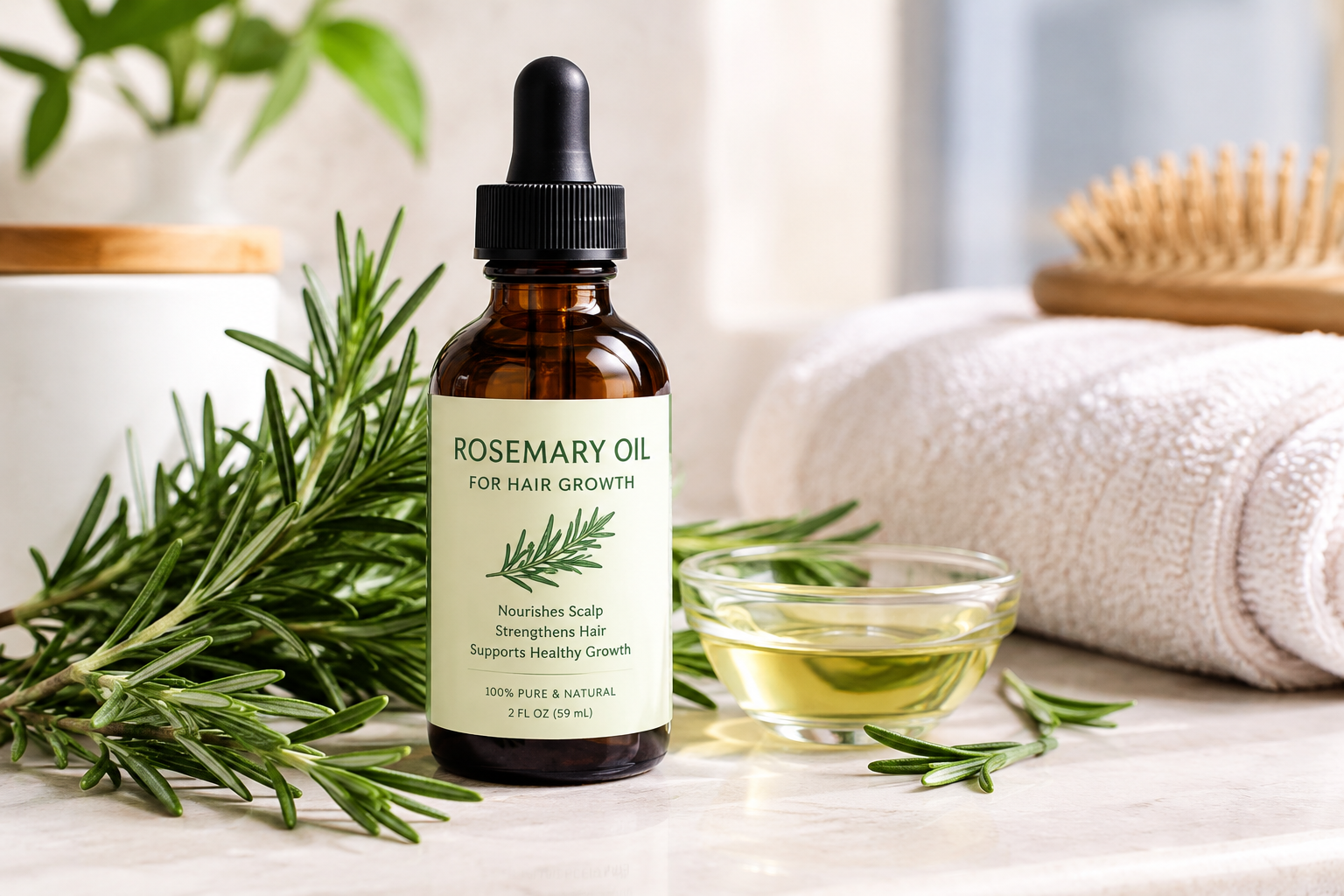
Rosemary oil has become a popular ingredient in hair-care routines for people hoping to improve scalp health, reduce breakage, and support fuller-looking hair. But does rosemary oil for hair growth actually work, and how should you use it?
The answer is more nuanced than social media before-and-after photos suggest. Some research is promising, but the available clinical evidence is limited, and results depend on the cause of hair loss, the formulation used, and individual scalp sensitivity.
In this guide, we’ll explore the potential benefits of rosemary oil, what research says, how to use it safely, and what to know before adding it to your routine.
Does Rosemary Oil Help Hair Growth?
Rosemary oil may help support hair growth, but there is not enough strong evidence to consider it a proven treatment for every type of hair loss.
One frequently cited clinical trial, published in 2015, compared rosemary oil with 2% minoxidil in 100 men with androgenetic alopecia, a common form of pattern hair loss. After six months, both groups showed an increase in hair count, with no statistically significant difference between the two groups. Neither group showed a significant improvement in hair count at three months.
However, the study did not include an untreated or placebo group, so it cannot establish how much improvement was caused by rosemary oil itself.
A 2024 review of natural alternatives for androgenetic alopecia also concluded that more research is needed to establish the effectiveness of rosemary oil and other complementary treatments.
The takeaway: Rosemary oil is a promising area of research, but it should not be presented as a guaranteed way to regrow hair or as a proven replacement for established hair-loss treatments.
Potential Benefits of Rosemary Oil for Hair
Rosemary essential oil is obtained from the rosemary plant and contains aromatic compounds studied for various biological properties. Its potential benefits for hair and scalp care include the following.
1. It May Support a Healthy Scalp
A healthy scalp is important for comfortable, manageable hair. Rosemary oil is studied for its antioxidant and other biological properties, but evidence that applying it directly improves scalp health in people is still limited.
If you experience persistent itching, redness, scaling, or inflammation, identify the cause instead of relying on essential oils alone.
2. It May Help Support Hair Density
Some research suggests that rosemary-based formulations may improve hair-count measurements over time. However, the evidence is not strong enough to promise that a rosemary oil product will increase hair density for everyone.
Hair thinning can have many causes, including genetics, hormonal changes, nutritional deficiencies, and certain medical conditions. Understanding the cause is important when choosing an appropriate treatment.
3. It May Be Useful in a Scalp Massage Routine
Some people incorporate diluted rosemary oil into scalp massage as part of their hair-care routine. Massage can help distribute a product across the scalp, but there is not enough evidence to say that the combination reliably stimulates new hair growth.
Avoid vigorous rubbing, particularly if your scalp is irritated or your hair is prone to breakage.
4. It May Complement a Hair-Care Routine
Rosemary oil can be included in a routine designed around scalp comfort and hair maintenance. However, it is not a substitute for cleansing, conditioning, gentle detangling, or medical treatment when hair loss has an underlying cause.
How to Use Rosemary Oil for Hair Growth
If you want to try rosemary oil, use a product intended for scalp application and follow its label instructions.
Step 1: Choose the Right Product
Look for a clearly labeled hair or scalp product. Some products contain rosemary essential oil diluted in carrier oils, while others contain rosemary extract or a proprietary blend.
These formulations are not interchangeable. The concentration and ingredients can affect how the product feels and how well your skin tolerates it.
Step 2: Check Whether It Needs Dilution
Pure rosemary essential oil is concentrated and should not be applied directly to the scalp undiluted.
Choose a pre-diluted product or follow appropriate dilution guidance from a qualified professional. Do not assume that every product marketed as rosemary oil has the same concentration.
Step 3: Patch-Test Before Regular Use
Test a small amount of the diluted product on a small area of skin according to the product instructions. Monitor for redness, itching, burning, swelling, or other signs of irritation.
A patch test cannot guarantee that you will never develop a reaction. Stop using the product if irritation occurs.
Step 4: Apply Carefully
Part your hair into sections and apply the product sparingly to the intended scalp areas. Follow the label for how much to use, whether to massage it in, and whether it should be washed out.
Avoid the eyes, broken skin, and other sensitive areas. Wash your hands after application.
Step 5: Keep Your Routine Consistent
If you tolerate the product, follow its directions consistently rather than applying increasingly large amounts in the hope of faster results.
More oil does not necessarily mean more growth. Excess product may leave residue, make hair greasy, or irritate the scalp.
How Often Should You Use Rosemary Oil for Hair Growth?
There is no universally established frequency for every rosemary oil product.
How often you should use it depends on the formulation, concentration, product directions, and your scalp’s tolerance. A ready-to-use scalp oil may have different instructions from a concentrated essential oil.
Start with the product’s directions and avoid increasing frequency if you experience itching, burning, redness, or excessive residue.
If you have a sensitive scalp or an existing scalp condition, consult a dermatologist before using an essential oil.
How Long Does Rosemary Oil Take to Work?
Rosemary oil is not an overnight solution for hair growth.
The often-cited 2015 clinical trial assessed results over six months. That does not mean everyone will see results at six months, nor does it establish that every commercial rosemary oil product works the same way.
Hair grows gradually, and visible changes can be influenced by hair length, breakage, lighting, styling, and the natural hair-growth cycle.
If you track changes, take photographs under consistent lighting and use the same parting and hairstyle. Avoid relying on dramatic online before-and-after images without information about the time period, other treatments, and whether the images are genuine.
If your hair loss is sudden, patchy, severe, or persistent, seek medical advice rather than waiting for an oil to work.
Rosemary Oil Before and After: What Results Can You Expect?
Before-and-after photographs can make rosemary oil appear more effective than the evidence establishes.
Changes in volume, styling, lighting, hair length, and breakage can all influence how hair looks in photographs. A picture alone cannot show whether new hair has grown or whether a product caused the change.
Research on particular rosemary-based formulations is not proof that every rosemary oil sold online produces the same results.
A realistic approach is to assess scalp comfort, hair manageability, and any measurable changes over time without assuming that fuller-looking hair necessarily means new growth.
Does Rosemary Oil Work for Curly, Coily, and Textured Hair?
Rosemary oil can be included in a hair-care routine for different textures, but evidence does not establish that it works better for curly, coily, or textured hair than for other hair types.
For textured hair, minimizing breakage and maintaining moisture can be especially important to retaining length. An oil may help with lubrication or reduce friction in some routines, depending on the formulation, but it does not replace a suitable conditioner or detangling product.
Consider these practical tips:
- Apply products in sections to help distribute them evenly.
- Avoid pulling or rubbing tightly coiled hair when massaging the scalp.
- Use a conditioner that provides enough slip for detangling.
- Wash away residue when needed rather than repeatedly layering oil onto the scalp.
- Stop using any product that causes irritation or discomfort.
Hair retention and hair growth are different. Reducing breakage may help you retain length even when the rate of growth from the scalp has not changed.
Rosemary Oil vs. Other Hair Oils
Different hair oils serve different purposes, and there is no single best option for everyone.
Rosemary Oil
Rosemary oil is popular for scalp-care routines and has limited but promising research related to hair growth. Concentrated essential oil requires appropriate dilution.
Castor Oil
Castor oil is a thicker oil commonly used to lubricate hair and help it feel conditioned. Strong clinical evidence that castor oil alone stimulates hair growth is lacking.
Coconut Oil
Coconut oil has evidence supporting its ability to reduce protein loss from hair under certain conditions. This relates to hair-shaft care, not proof that it regrows hair at the scalp.
Choosing an oil should depend on your goal. A product that helps reduce friction and breakage is not necessarily a treatment for pattern hair loss.
For another perspective, read our guide to castor oil for hair growth.
Possible Side Effects and Precautions
Rosemary essential oil can cause skin irritation or allergic contact dermatitis in some people. Concentrated oil may be particularly irritating when used incorrectly.
To use it more cautiously:
- Never apply concentrated essential oil directly to the scalp unless a product is specifically formulated for direct use.
- Avoid applying it to broken or irritated skin.
- Keep it away from your eyes.
- Stop using it if you develop burning, a rash, swelling, or persistent itching.
- Ask a healthcare professional before using essential oils if you are pregnant, breastfeeding, or considering use on a child.
If you experience a significant reaction, seek appropriate medical advice.
When Should You See a Dermatologist?
Hair shedding can happen for many reasons, and the appropriate treatment depends on the cause.
Consider a dermatologist if you notice sudden or patchy hair loss, a widening part, progressive thinning, scalp pain, persistent inflammation, or hair loss that continues despite changes to your routine.
A clinician can help identify whether the issue involves pattern hair loss, a scalp condition, nutritional factors, medication effects, or another cause. Evidence-based treatments may be more appropriate than relying on oils alone.
Frequently Asked Questions
Is rosemary oil scientifically proven to grow hair?
Evidence is limited but promising. A small clinical trial found increased hair counts after six months in participants using rosemary oil, but stronger independent studies are needed to establish its effectiveness.
Can I apply rosemary oil directly to my scalp?
Do not apply concentrated rosemary essential oil undiluted. Choose a product formulated for scalp use and follow its instructions.
How often should I use rosemary oil?
Follow the directions for your specific product. There is no single evidence-based frequency that applies to every formulation.
Can rosemary oil reduce hair breakage?
It has not been established as a direct treatment for hair breakage. A suitable conditioner, gentle detangling, and reduced mechanical stress are more established parts of a breakage-conscious routine.
Is rosemary oil better than castor oil?
There is insufficient evidence to conclude that rosemary oil is universally better. Rosemary oil has some limited research relating to hair growth, while castor oil is mainly used as a conditioning oil and lacks strong evidence as a hair-growth treatment.
Can I leave rosemary oil on overnight?
Whether a product can be left on overnight depends on its formulation and label instructions. Do not assume that prolonged contact is better, especially if your scalp is sensitive.
Does rosemary oil work for everyone?
No. Results are uncertain, and hair loss has many causes. Some people may not benefit, and others may experience irritation.
Final Thoughts
Rosemary oil for hair growth is a popular topic with some encouraging research, but the evidence remains limited. The best-known clinical trial assessed a particular preparation over six months; it does not prove that every rosemary oil product will regrow hair.
If you decide to try it, choose an appropriate product, follow its instructions, monitor your scalp’s response, and keep expectations realistic. Most importantly, investigate persistent or unusual hair loss instead of relying on an oil alone.
Sources for further reading
- An Overview of Commonly Used Natural Alternatives for the Treatment of Androgenetic Alopecia, with Special Emphasis on Rosemary Oil — Clinical, Cosmetic and Investigational Dermatology (2024)
- Do Non-Prescription Products Help in Managing Androgenic Alopecia? — Review of available evidence
This article is for general educational purposes and is not a substitute for individualized medical advice.