Retinal vs retinol is one of the most useful skincare comparisons for anyone interested in smoother texture, fine lines, uneven skin tone or acne-prone skin. Both ingredients belong to the retinoid family, but they differ in how the skin processes them.
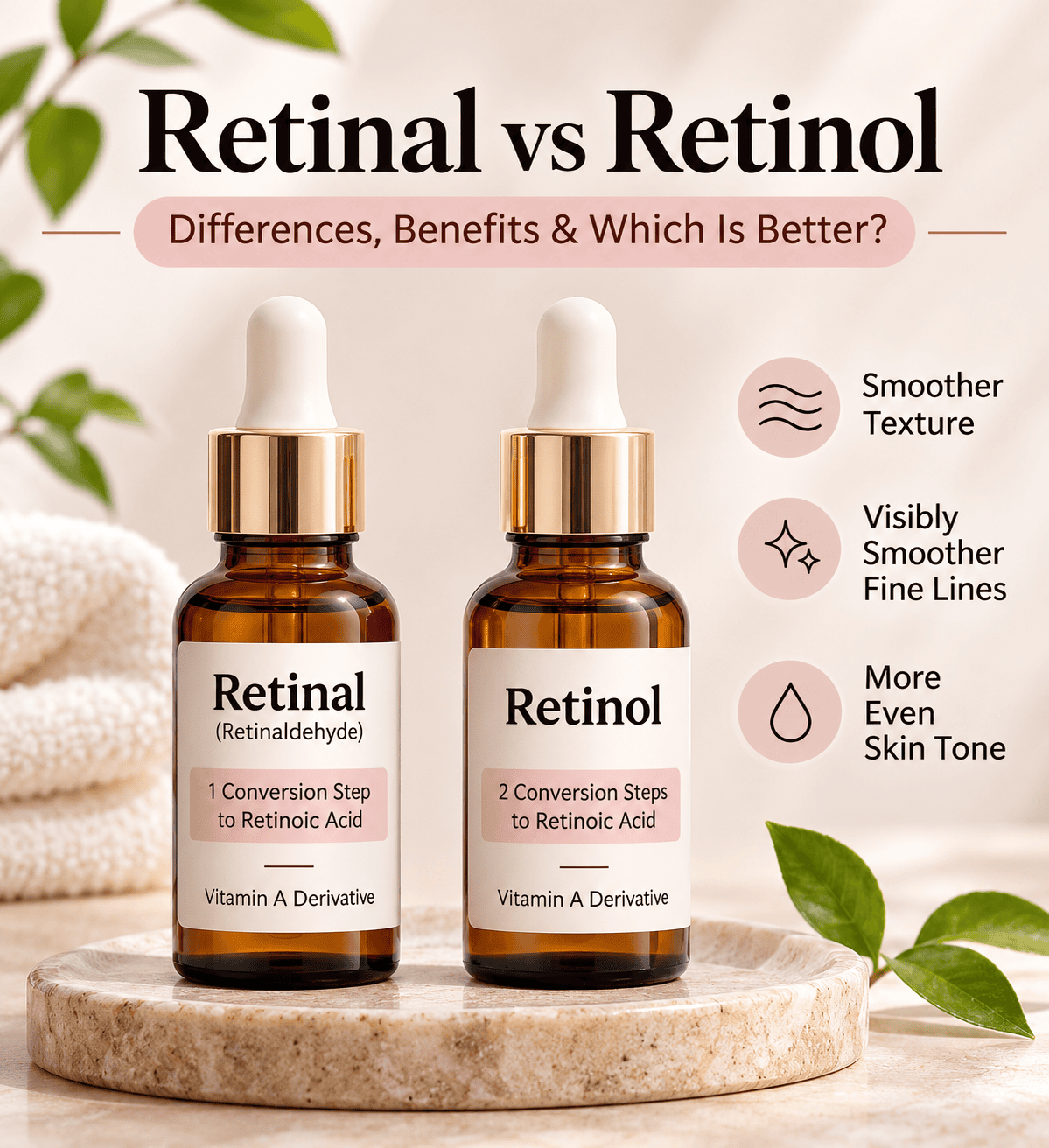
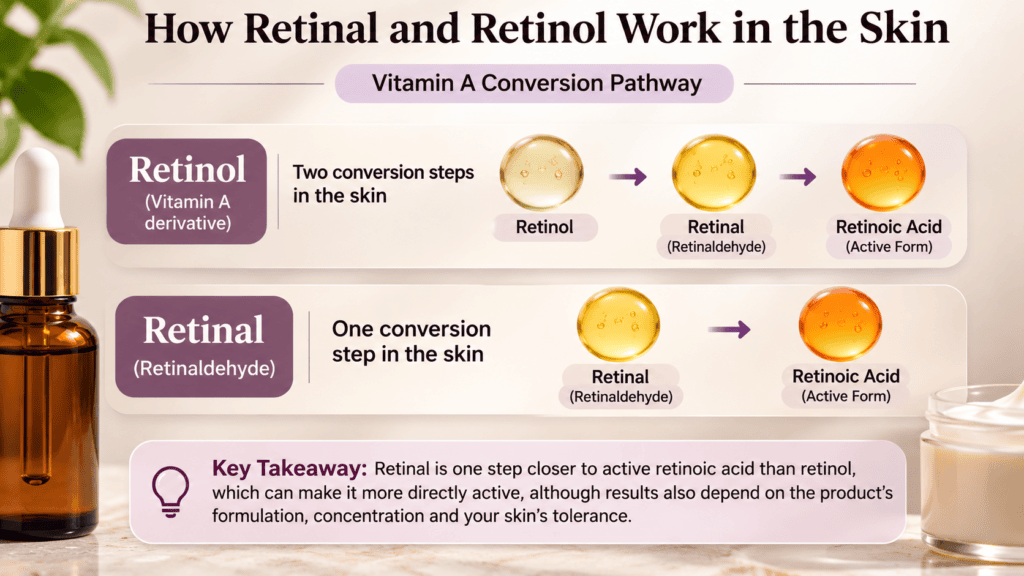
Retinal, also called retinaldehyde, requires one conversion step to become retinoic acid. Retinol requires two. Because of this difference, retinal is often described as the more directly acting cosmetic retinoid.
However, that does not mean retinal is automatically the best choice for everyone. Product concentration, formulation, skin sensitivity and consistent use all influence results.
So, should you choose retinal or retinol? This guide explains the science, benefits, differences, possible side effects and how to introduce either ingredient into your skincare routine.
Quick Answer: Is Retinal Better Than Retinol?
Retinal is one conversion step closer to active retinoic acid than retinol, which gives it the potential for greater biological activity. However, a well-formulated retinol product may work better for your skin than a poorly formulated or irritating retinal product.
Retinol is a reasonable starting option for many beginners, especially when available in a gentle, lower-strength formula. Meanwhile, retinal may appeal to people who already tolerate vitamin A skincare and want to explore another option.
Neither ingredient guarantees faster results, and both can cause dryness, redness or peeling.
The best choice is the product your skin can tolerate consistently.
What Is Retinal in Skincare?
Retinal, or retinaldehyde, is a vitamin A derivative commonly included in serums and night creams.
It belongs to the retinoid family, which includes retinol, tretinoin and adapalene.
When applied to skin, retinal can be converted into retinoic acid, the biologically active form involved in regulating skin-cell behavior.
Consequently, retinal is used in cosmetic formulas designed to improve the appearance of fine lines, uneven texture and signs of sun damage.
Benefits of Retinal
Retinal-containing skincare products may help with:
- Improving the appearance of fine lines.
- Supporting smoother-looking skin texture.
- Reducing the appearance of uneven pigmentation over time.
- Supporting skin renewal.
- Improving certain mild acne-related concerns, although cosmetic retinal is not a substitute for proven prescription acne treatment.
However, retinal can irritate the skin, particularly when introduced too frequently or combined with other strong active ingredients.
A gentle moisturizer and gradual introduction can help reduce that risk.
What Is Retinol in Skincare?
Retinol is another vitamin A derivative widely used in over-the-counter skincare products.
It is particularly common in facial serums, moisturizers and nighttime treatments.
Unlike retinal, retinol must undergo two conversion steps before becoming retinoic acid.
First, the skin converts retinol into retinaldehyde. Then retinaldehyde can be converted into retinoic acid.
Although this pathway is longer, retinol remains a well-researched cosmetic ingredient.
Benefits of Retinol
Depending on the formulation, retinol may help:
- Soften the appearance of fine lines.
- Improve uneven skin tone.
- Make rough skin texture appear smoother.
- Support the appearance of healthier, more even-looking skin.
- Improve mild blemish-related concerns in some users.
However, over-the-counter retinol products vary considerably in strength and stability.
A product labeled with a high percentage is not automatically more effective than a lower-strength formula.
Retinal vs Retinol: Key Differences
The following table summarizes the most important differences.
| Feature | Retinal | Retinol |
|---|---|---|
| Full ingredient name | Retinaldehyde | Retinol |
| Ingredient family | Vitamin A derivative | Vitamin A derivative |
| Conversion to retinoic acid | One step | Two steps |
| Potential biological activity | More direct precursor | Requires an additional conversion |
| Main cosmetic uses | Fine lines, texture, uneven tone | Fine lines, texture, uneven tone |
| Irritation potential | Can cause dryness and irritation | Can cause dryness and irritation |
| Beginner suitability | Depends on formula and tolerance | Gentle formulas are often a practical starting choice |
| Availability | Found in selected cosmetic products | Widely available in skincare |
| Evidence | Promising, with fewer direct comparisons between finished products | Substantial research, but results vary by formula |
| Pregnancy | Avoid | Avoid |
Important: The conversion pathway alone cannot determine which finished product will deliver better results. The complete formulation matters.
How Do Retinal and Retinol Work?
Both ingredients act as precursors to retinoic acid.
Retinoic acid influences processes involved in skin-cell differentiation, renewal and collagen regulation.
The simplified conversion pathway is:
Retinol → Retinaldehyde → Retinoic Acid
Retinal starts one step closer:
Retinaldehyde → Retinoic Acid
This difference explains why retinal is often marketed as a stronger alternative to retinol.
However, actual skin metabolism is more complicated. Not every molecule applied to the face is converted into active retinoic acid.
Some retinaldehyde can also be converted into storage forms of vitamin A.
Furthermore, the amount of active ingredient reaching the skin depends on product stability, formulation and delivery.
Therefore, it is misleading to claim that retinal is always a fixed number of times stronger than retinol.
Retinal vs Retinol for Fine Lines and Wrinkles
Both ingredients may improve the appearance of mild fine lines with consistent use.
Retinoids have been studied for their effects on photoaging, skin texture and collagen-related processes.
Is Retinal Better for Wrinkles?
Retinal has a shorter conversion pathway and may provide useful cosmetic benefits.
However, research has not established that every retinal serum produces better wrinkle improvement than every retinol serum.
For example, a carefully formulated retinol cream used consistently may outperform a retinal serum that causes repeated irritation and cannot be used regularly.
Is Retinol Effective for Fine Lines?
Retinol has supporting clinical evidence for improving signs of skin aging, although results vary between formulations.
Consistency and sun protection remain essential.
For either ingredient, improvement is gradual rather than immediate. Most users should expect to assess results over several months rather than days.
Retinal vs Retinol for Acne-Prone Skin
Retinoids play an established role in acne treatment, particularly by helping prevent clogged pores.
However, not all retinoids have the same medical evidence or regulatory approval.
Prescription tretinoin and certain adapalene formulations have stronger established roles in acne treatment than cosmetic retinal or retinol serums.
Should You Choose Retinal for Acne?
A retinal-containing product may be worth considering for mild cosmetic concerns in someone who tolerates retinoids.
Nevertheless, evidence does not justify treating every retinal serum as a replacement for medically established acne treatments.
Can Retinol Help Acne?
Some retinol products may improve the appearance of mild blemish-prone skin over time.
However, if you have frequent inflammatory breakouts, painful cysts or acne scars, a dermatologist can recommend treatments with stronger clinical evidence.
If your main concerns are breakouts and lingering marks, you can also read our Azelaic Acid for Acne and Dark Spots guide to explore another ingredient used in acne-related skincare.
Retinal vs Retinol for Dark Spots and Uneven Skin Tone
Uneven pigmentation can develop after acne, inflammation and sun exposure.
Retinoids may help improve some forms of uneven skin tone over time.
However, neither retinal nor retinol should be presented as a guaranteed treatment for every type of pigmentation.
The underlying cause matters.
For example, post-acne marks, sun-related spots and melasma may require different approaches.
Which Ingredient Is Better for Hyperpigmentation?
There is no universal winner.
A retinal product may be suitable for someone who already tolerates retinoids. Meanwhile, a gentle retinol formula may be easier for some beginners to incorporate.
The most important consideration is avoiding unnecessary irritation.
Inflammation can worsen discoloration, especially in people whose skin develops dark marks after irritation.
Additionally, daily sunscreen is essential because ultraviolet exposure can contribute to persistent pigmentation.
Retinal vs Retinol for Sensitive Skin
Sensitive skin requires extra care when using retinoids.
Both ingredients can cause:
- Redness.
- Dryness.
- Tightness.
- Flaking.
- Burning or stinging.
- Irritation around the nose, mouth or eyes.
Retinol is often a practical starting point because gentle formulations are widely available. For a gentler retinoid alternative, some people consider bakuchiol.
However, retinal should not automatically be described as harsh, nor should retinol automatically be described as gentle.
A product containing either ingredient may be well tolerated or irritating depending on its concentration and formulation.
What If You Have a Damaged Skin Barrier?
If your skin is already stinging, peeling or reacting to basic moisturizers, introducing a retinoid may make the problem worse.
Instead, focus first on gentle cleansing and moisturizing.
Our Skin Barrier Repair guide explains how to simplify your routine when your skin feels irritated or compromised.
If you have eczema, active rosacea or persistent inflammation, consult a dermatologist before starting a retinoid.
How to Choose Between Retinal and Retinol
Your skin type, experience and main concerns are more useful than simply choosing whichever ingredient sounds stronger.
| Your situation | Practical approach |
|---|---|
| Completely new to retinoids | Consider a gentle, lower-strength retinol product |
| Already tolerating retinol | Retinal may be an option if you want to try a different formulation |
| Sensitive or easily irritated skin | Prioritize barrier care and discuss retinoids with a dermatologist |
| Mild fine lines and texture concerns | Either ingredient may be suitable |
| Moderate or severe acne | Seek an evidence-based acne treatment recommendation |
| Existing eczema or active rosacea | Avoid self-starting during a flare and seek professional advice |
| Pregnant or trying to conceive | Avoid retinal, retinol and other retinoids |
Our recommendation: Do not switch ingredients merely because one is marketed as faster or stronger.
If a retinol formula works well for your skin, there may be no need to replace it.
How to Start Retinal or Retinol Safely
Introducing a retinoid slowly can help reduce irritation.
Step 1: Choose One Retinoid
Start with either retinal or retinol, not both.
Using multiple retinoid products in the same routine increases complexity and may cause unnecessary irritation.
Step 2: Test the Product First
Follow the product’s patch-testing guidance before applying it across your face.
This is especially useful if your skin reacts easily to new cosmetics.
Step 3: Begin With a Few Nights Per Week
For many beginners, using the product two nights per week is a cautious starting approach.
If the skin remains comfortable, you may gradually increase frequency according to the label instructions and your dermatologist’s guidance.
Do not force daily use if your skin becomes irritated.
Step 4: Cleanse Gently
Use a mild cleanser and lukewarm water.
Avoid scrubbing or using harsh exfoliating cleansers immediately before application.
Step 5: Apply to Dry Skin
After cleansing, allow your skin to dry before applying the product.
Applying retinoids to damp skin may increase irritation for some people.
Step 6: Use the Recommended Amount
Follow the label instructions.
For many facial retinoid products, a thin layer is sufficient.
Avoid excessive application, and keep the product away from the eyes, lips and irritated skin unless it is specifically formulated and directed for those areas.
Step 7: Follow With Moisturizer
Choose a gentle, fragrance-free moisturizer.
Ingredients such as glycerin, ceramides and hyaluronic acid can help support hydration.
If your skin is sensitive, applying moisturizer before your retinoid may reduce irritation, although you should follow the instructions for your specific product.
Step 8: Wear Sunscreen Every Morning
Use a broad-spectrum sunscreen with SPF 30 or higher.
Sunscreen helps protect against sun damage and supports your efforts to improve fine lines and pigmentation.
It is an essential part of a skincare routine whether or not you use retinoids.
Morning and Night Routine With Retinal or Retinol
You do not need a complicated routine to use vitamin A skincare.
| Step | Morning routine | Evening routine |
|---|---|---|
| 1 | Gentle cleanser | Gentle cleanser |
| 2 | Optional hydrating serum | Retinal or retinol on scheduled nights |
| 3 | Moisturizer | Moisturizer |
| 4 | Broad-spectrum SPF 30+ sunscreen | No additional strong active required |
On nights when you are not using a retinoid, a simple cleanser-and-moisturizer routine is often enough.
For more guidance on morning skincare, see our Morning Skincare Routine guide.
Can You Use Retinal or Retinol With Other Ingredients?
Some skincare ingredients work well alongside retinoids. Others require more caution. Other anti-ageing ingredients, such as copper peptides, are also sometimes used in routines that include a retinoid.
Niacinamide
Niacinamide is commonly used in moisturizing and barrier-supporting skincare.
It can generally fit into a routine that includes retinal or retinol, provided the overall formula does not irritate your skin.
Learn more in our Niacinamide Benefits for Skin guide.
Hyaluronic Acid
Hyaluronic acid is a humectant used to support skin hydration.
It can be particularly useful in a moisturizing routine when retinoids cause temporary dryness.
Our Hyaluronic Acid guide explains how this ingredient works.
Ceramides and Glycerin
Ceramides and glycerin are common ingredients in moisturizers designed to reduce dryness and support comfortable skin.
They are practical additions to a retinoid routine. Learn more in our guide to Ceramides for Skin.
Glycolic Acid and Other Exfoliating Acids
Glycolic acid, salicylic acid and other exfoliating ingredients can contribute to irritation when introduced alongside a retinoid.
Beginners should avoid starting several powerful active ingredients together.
If you want to use both categories, discuss an appropriate schedule with a dermatologist or introduce them cautiously on separate days when tolerated.
Vitamin C
Some people use vitamin C products in the morning and retinoids at night.
However, there is no need to add vitamin C immediately when starting a retinoid.
Focus on establishing a comfortable routine first.
How Long Does Retinal or Retinol Take to Work?
Neither ingredient produces an overnight transformation.
The time required depends on the product, concentration, skin concern and consistency.
Here is a practical timeline:
| Time using product | What to expect |
|---|---|
| First 1–2 weeks | Skin may begin adjusting; irritation is possible |
| Weeks 3–6 | Tolerance may improve with careful use; visible results may still be limited |
| Weeks 6–12 | Some users may notice improvements in texture or fine lines |
| After 3 months | A more useful point to assess consistent cosmetic results |
| Beyond 3–6 months | Continued improvement may occur, depending on the formula and skin concern |
These are broad expectations, not guaranteed milestones.
If your skin remains irritated, reduce use or stop the product rather than trying to push through discomfort.
Common Mistakes When Using Retinal or Retinol
1. Choosing the Strongest Product Immediately
A high-strength formula may cause irritation without producing better results for your skin.
Start with a product suitable for your experience level.
2. Applying Too Much
Using more than directed does not guarantee faster improvement.
Excessive application can increase dryness, peeling and redness.
3. Combining Too Many Active Ingredients
Starting retinoids, exfoliating acids and other strong treatments at the same time makes irritation more likely.
Introduce new ingredients separately.
4. Skipping Moisturizer
Moisturizing helps maintain skin comfort and can make retinoid use easier to tolerate.
5. Forgetting Sunscreen
Retinoids should be accompanied by consistent sun protection.
Without proper sun protection, efforts to improve sun-related pigmentation and photoaging may be undermined.
6. Assuming Every Breakout Is Purging
Some people experience temporary changes in breakouts after starting retinoids.
However, persistent worsening, burning or a rash should not automatically be dismissed as purging.
Stop using a product that causes a significant reaction and seek medical advice when necessary.
7. Expecting Results Within Days
Retinoids require consistency and patience.
Switching products constantly can make it harder to identify which formula works for your skin.
Who Should Avoid Retinal and Retinol?
Do not use retinal, retinol or other retinoids during pregnancy. If you are pregnant or trying to conceive, consult your healthcare professional about appropriate skincare alternatives.
If you are breastfeeding, discuss retinoid use with your healthcare professional because recommendations depend on the ingredient, formulation and circumstances.
You should also seek individual advice before using retinoids if you have:
- Active eczema or significant skin inflammation.
- Poorly controlled rosacea.
- Persistent skin irritation or a damaged skin barrier.
- A known allergy to a product ingredient.
- A complicated skincare treatment plan involving prescription medications.
Children and teenagers should not begin cosmetic anti-aging retinoids without appropriate professional guidance.
Frequently Asked Questions
Is retinal stronger than retinol?
Retinal is one conversion step closer to retinoic acid, giving it a more direct metabolic pathway. However, that does not prove every retinal product is stronger or more effective than every retinol product.
Is retinal better than retinol for beginners?
Not necessarily. Many beginners find gentle retinol products a practical introduction to retinoids. However, individual tolerance and formulation matter more than the ingredient name alone.
Can retinal help with wrinkles?
Retinal-containing products may improve the appearance of fine lines and skin texture. However, results depend on the formula, consistent use and individual skin response.
Can I use retinal and retinol together?
It is generally unnecessary to use both in the same routine. Choose one retinoid unless a dermatologist recommends a specific combination or treatment plan.
Is 0.1% retinal stronger than 1% retinol?
You cannot determine the clinical performance of two finished products from those percentages alone. Formulation, ingredient stability, delivery and tolerability matter.
Can I use retinol or retinal every night?
Some people eventually tolerate nightly use, but beginners should generally start less frequently. Increase use only when your skin tolerates the product and the label instructions allow it.
Which is better for acne, retinal or retinol?
Neither is universally better. Cosmetic retinoids may help certain mild concerns, but established acne medications, including adapalene and prescription tretinoin, have stronger evidence for treating acne.
Is retinal the same as tretinoin?
No. Retinaldehyde is a precursor that can convert into retinoic acid. Tretinoin is retinoic acid itself and is regulated as a medication in many countries.
Can I use retinal or retinol with niacinamide?
Generally, yes. Niacinamide can fit into a routine containing a retinoid. Introduce products gradually and monitor for irritation.
Can I use retinal or retinol during pregnancy?
No. Dermatology guidance recommends avoiding topical retinoids during pregnancy. Speak with your obstetrician or dermatologist about safer alternatives.
Do I need sunscreen when using retinol?
Yes. Use broad-spectrum SPF 30 or higher sunscreen during the day and follow other sun-protection practices such as seeking shade and wearing protective clothing.
How long should I try retinol before switching to retinal?
There is no universal switching deadline. Allow sufficient time to evaluate the product, often several months, unless it causes irritation. If your current product works well, switching may be unnecessary.
Final Thoughts: Which Is Better, Retinal or Retinol?
The retinal vs retinol debate does not have one answer for every skin type.
Retinal requires one conversion step to become retinoic acid, whereas retinol requires two. This gives retinal a more direct metabolic pathway.
However, a shorter pathway does not guarantee better results from every finished product.
For many beginners, a gentle retinol formula is a reasonable starting option. Meanwhile, retinal may be worth considering for people who already tolerate retinoids and prefer to explore another formulation.
Ultimately, the right choice depends on your skin goals, sensitivity, product quality and how consistently you can use it.
Remember: A simple routine containing a gentle cleanser, moisturizer, suitable retinoid and daily sunscreen is usually more useful than combining numerous strong products.
If dark spots are your main concern, see our guide to the best ingredient for dark spots.
Medical Disclaimer
This article is provided for general educational and informational purposes only. It is not medical advice and does not replace professional diagnosis or treatment.
Retinal, retinol and other retinoids can cause irritation and may be unsuitable for people with certain skin conditions. Retinoids should be avoided during pregnancy.
If you are pregnant, trying to conceive, breastfeeding, using prescription skincare medication or experiencing persistent skin problems, consult a qualified dermatologist or healthcare professional before introducing a retinoid.
Individual results vary depending on skin type, product formulation, frequency of use and other factors.
Sources and References
The following dermatology resources and scientific publications informed this article.
- American Academy of Dermatology — Retinoid or Retinol? — Benefits, skin sensitivity, gradual introduction and sun protection.
- A Clinician’s Guide to Topical Retinoids — Retinoid types and the conversion of retinol and retinaldehyde into retinoic acid.
- Use of Retinoids in Topical Antiaging Treatments: A Focused Review of Clinical Evidence — Clinical evidence, formulation considerations and retinoid mechanisms.
- DermNet — Topical Retinoids — Medical uses, side effects, precautions and contraindications.
- American Academy of Dermatology — Dermatologist-Approved Pregnancy Skin Care — Pregnancy-related skincare precautions.
- American Academy of Dermatology — Wrinkle Remedies — Sunscreen, moisturizer, product testing and realistic timelines.
Editorial note: This article was prepared using publicly available dermatology guidance and scientific literature. It does not claim independent clinical testing or hands-on product trials.