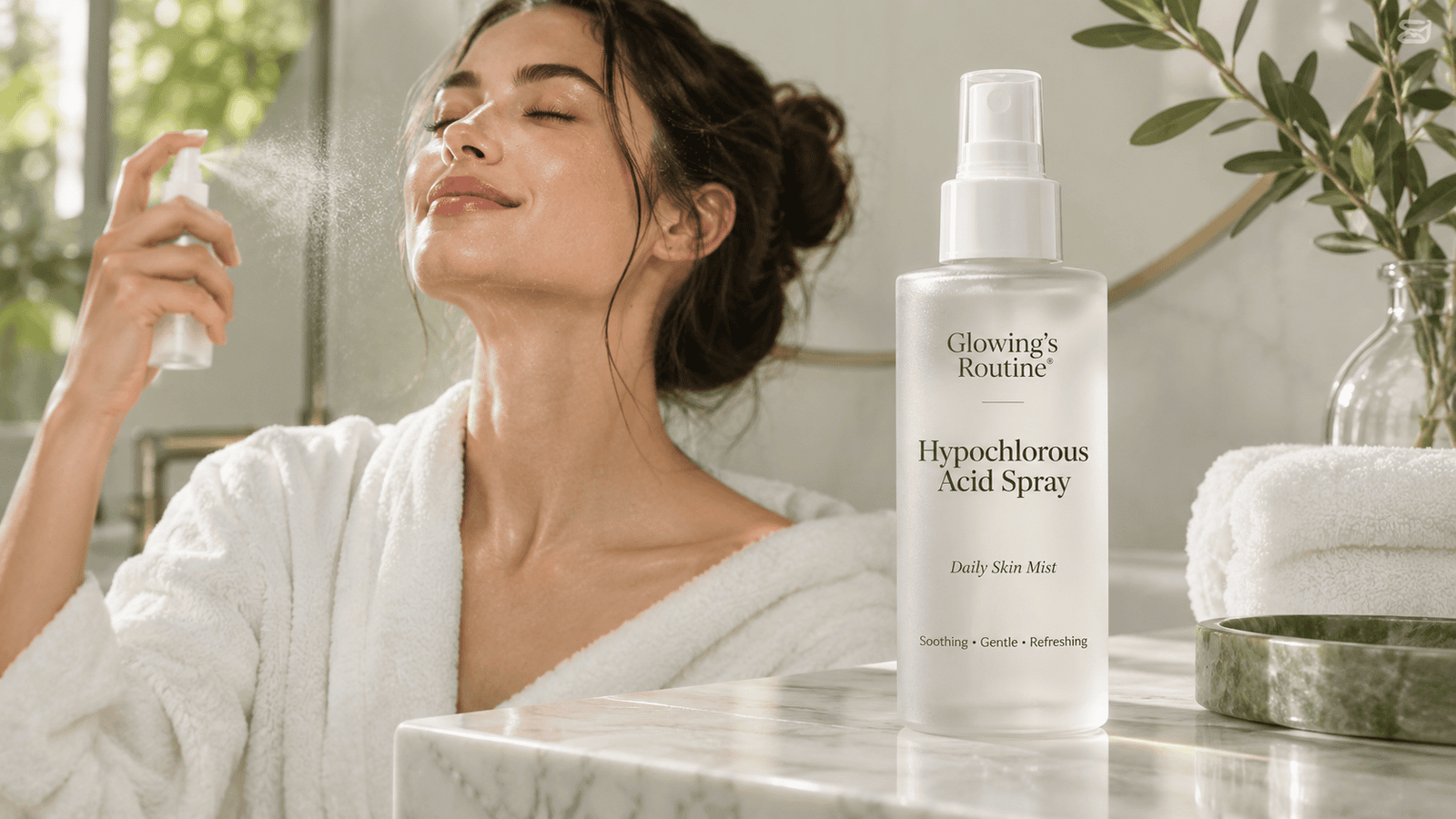
Hypochlorous acid spray for skin has become one of the most talked-about products in skincare, especially among people dealing with breakouts, redness, and sensitive skin. Unlike traditional acne treatments or exfoliating acids, this lightweight mist is designed to offer antimicrobial support without the harsh feeling associated with some stronger products.
But does hypochlorous acid spray actually work, or is it another skincare trend with more hype than evidence?
The answer is somewhere in between.
Hypochlorous acid (HOCl) has established antimicrobial properties and a history of use in medical skin and wound-care products. More recently, facial sprays containing this ingredient have gained attention for their potential to help manage acne-related bacteria, soothe irritated skin, and complement everyday skincare routines.
However, hypochlorous acid spray is not a miracle treatment, and not every advertised benefit has been confirmed by large clinical studies.
In this guide, you’ll discover what hypochlorous acid is, its potential benefits for skin, how to use it correctly, which ingredients to be careful combining it with, and how to choose a suitable facial spray.
Quick answer: Hypochlorous acid spray is a water-based skincare product containing a gentle antimicrobial compound. It may help reduce bacteria on the skin and provide supportive care for some types of irritation. Many people tolerate it well, but it cannot replace moisturizer, sunscreen, or medical treatment for conditions such as acne and eczema.
What Is Hypochlorous Acid Spray?
Hypochlorous acid, commonly abbreviated as HOCl, is a weak acid that naturally forms as part of the body’s immune response.
Hypochlorous acid spray is not a replacement for established acne treatments. If you’re also dealing with breakouts and post-acne dark spots, explore our Azelaic Acid for Acne and Dark Spots guide to understand how this skincare ingredient works and what to consider before using it.
Certain white blood cells produce hypochlorous acid to help defend the body against harmful microorganisms.
Scientists can also manufacture hypochlorous acid solutions, commonly through processes involving water, salt, and electrolysis.
When carefully formulated for topical use, these solutions can provide antimicrobial activity while remaining relatively gentle on healthy skin.
According to Cleveland Clinic, hypochlorous acid is used in several types of products, including facial sprays, wound-care solutions, and disinfectants.
However, these products are not interchangeable. Their concentrations, formulations, and intended uses can differ significantly.
How Does Hypochlorous Acid Work on Skin?
Hypochlorous acid is an oxidizing compound that can damage essential components of microorganisms, helping reduce certain bacteria and other microbes.
It has also demonstrated anti-inflammatory activity in laboratory and clinical research, although the strength of evidence varies depending on the formulation and skin condition.
For everyday skincare, this means a properly formulated hypochlorous acid spray may provide gentle antimicrobial support.
Nevertheless, healthy skin contains many beneficial microorganisms. The goal of skincare is not to sterilize your face or eliminate every bacterium.
If your skin frequently feels tight, irritated or uncomfortable after using skincare products, your skin barrier may need extra attention. Read our Skin Barrier Repair guide to learn about gentle cleansing, moisturizing ingredients and simple routines for stressed skin.
Instead, a facial HOCl spray should be considered an optional supporting product within a balanced skincare routine.
Is Hypochlorous Acid the Same as Bleach?
No, a hypochlorous acid facial spray is not the same product as household bleach.
The chemistry is related: hypochlorous acid and hypochlorite are chlorine-containing substances that can exist in equilibrium under different conditions.
However, household bleach typically contains sodium hypochlorite in a much more alkaline formulation and is not suitable for direct facial application.
Skin-friendly hypochlorous acid products are formulated with controlled concentrations and pH levels for their intended uses.
Important: Never apply household bleach, surface disinfectants, or homemade cleaning solutions to your face. Only use a product specifically labeled for the skin or body area you intend to treat.
Hypochlorous Acid Spray Benefits for Skin
Interest in hypochlorous acid spray has grown because it offers a different approach from traditional skincare ingredients.
Instead of exfoliating the skin or increasing cell turnover, it primarily works through antimicrobial activity.
Here are its most relevant potential benefits, along with what current research actually supports.
1. May Help Reduce Acne-Causing Bacteria
One of the most discussed benefits of hypochlorous acid spray is its potential usefulness for acne-prone skin.
Acne is a complex condition involving clogged pores, excess sebum, inflammation, and bacteria such as Cutibacterium acnes.
Because hypochlorous acid has antimicrobial properties, it may help reduce some of the bacteria associated with breakouts.
A review published in Cutis in July 2026 examined topical hypochlorous acid as a potential acne treatment. The authors reported encouraging early findings but emphasized the need for larger controlled studies.
This distinction matters.
Although hypochlorous acid may support acne care, it does not reliably unclog pores or regulate oil production in the way established acne treatments target specific aspects of the condition.
Therefore, it should not replace ingredients or medications recommended by a dermatologist, such as benzoyl peroxide, adapalene, or other prescribed treatments.
Best takeaway: Hypochlorous acid spray may be useful as an additional step for some people with acne-prone skin, but it is not a proven standalone acne cure.
2. May Soothe Redness and Skin Irritation
Sensitive skin can react to weather changes, fragrances, over-cleansing, and certain active ingredients.
Hypochlorous acid has been studied for antimicrobial and inflammation-related effects, which may help explain why some people find facial sprays soothing.
Unlike exfoliating acids, HOCl does not work by intentionally removing surface skin cells.
Furthermore, many facial sprays contain very few additional ingredients, which can be helpful for people trying to keep their routines simple.
However, not every case of redness has the same cause.
Persistent flushing, burning, or irritation may indicate rosacea, contact dermatitis, or another skin condition requiring professional assessment.
Hypochlorous acid should not be expected to treat all forms of redness equally.
3. May Provide Support for Eczema-Prone Skin
Eczema-prone skin often has a weakened protective barrier, making it more vulnerable to dryness, irritation, and certain microorganisms.
Some hypochlorous acid formulations have been investigated for their potential role in managing skin irritation and microbial activity associated with eczema.
For example, a 2025 review published in Biomedicines examined clinical applications of hypochlorous acid across multiple medical specialties, including dermatology.
However, the findings from medical preparations cannot automatically be applied to every cosmetic facial mist.
A gentle, fragrance-free HOCl spray may be suitable for some individuals with sensitive or eczema-prone skin, but it does not replace emollients or prescribed anti-inflammatory treatment.
If eczema causes painful cracks, bleeding, severe itching, or persistent inflammation, consult a healthcare professional.
4. May Support Skin Hygiene After Workouts
Sweat, friction, and tight workout clothing can contribute to discomfort and breakouts for some people.
Hypochlorous acid spray may provide a convenient antimicrobial step after exercising, especially when immediate cleansing is not practical.
For example, someone who experiences occasional irritation after wearing a helmet or sports equipment may find a gentle skin-friendly spray useful.
However, the spray does not physically remove sweat, sunscreen, oil, or dirt.
Whenever possible, washing with an appropriate gentle cleanser remains the better approach for removing buildup.
Practical tip: Consider HOCl spray a convenient supplementary step, not a complete replacement for cleansing after exercise.
5. Has Established Uses in Certain Wound-Care Products
Hypochlorous acid has a longer history in medical wound management than in cosmetic facial skincare.
Certain specially formulated products are used by healthcare professionals for wound cleansing and skin preparation.
Their antimicrobial action may help support an environment suitable for healing.
However, medical wound-cleansing products have specific formulations and instructions.
A regular cosmetic facial spray should not automatically be used to treat open wounds, infected cuts, surgical sites, or burns.
For significant skin injuries, follow the recommendations of a qualified healthcare professional.
What Does the Research Say About Hypochlorous Acid?
Despite its popularity, it is useful to separate established properties from emerging skincare claims.
| Claim | Current evidence |
|---|---|
| Antimicrobial activity | Well established for appropriate formulations |
| Use in medical skin and wound care | Supported for certain products and applications |
| Helping acne-prone skin | Promising early research; more controlled trials needed |
| Soothing sensitive or irritated skin | Potential benefit, but results vary |
| Managing eczema symptoms | Some clinical research, not a replacement for standard treatment |
| Treating rosacea | Limited condition-specific evidence |
| Fading dark spots or acne scars | No convincing evidence for ordinary facial sprays |
| Replacing moisturizer or sunscreen | Not supported |
The important difference is between what hypochlorous acid can do chemically and what a specific facial spray has been clinically shown to do.
A promising ingredient does not automatically make every product effective.
For readers interested in scientific evidence, the research review Topical Hypochlorous Acid for Acne Vulgaris provides additional information about its potential role in acne care.
How to Use Hypochlorous Acid Spray on Your Face
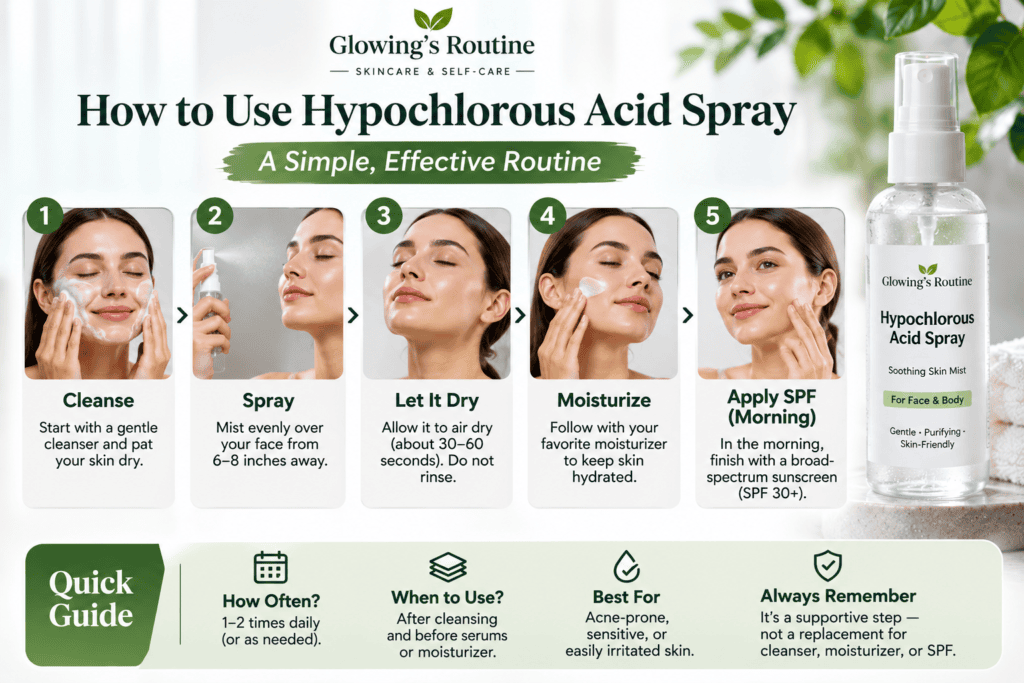
One advantage of hypochlorous acid spray is its relatively simple application.
Most facial products can be introduced without changing an entire skincare routine.
However, the directions on your particular product should always take priority.
Step 1: Start With Clean Skin
Begin with a gentle cleanser suited to your skin type.
Remove makeup, sunscreen, excess oil, and daily buildup.
Pat your face dry with a clean towel.
Using a hypochlorous acid spray on clean skin allows it to contact the skin directly rather than relying on it to penetrate layers of makeup or skincare products.
During colder months, low humidity and indoor heating can make the skin feel drier and more sensitive. A gentle cleansing and moisturizing routine remains essential, regardless of whether you use a facial spray. Our Winter Skin Care Routine guide explains how to adjust your daily skincare habits when temperatures drop.
Step 2: Apply the Spray Evenly
Follow the spraying distance and amount recommended on the product label.
Apply a light, even mist over the intended areas.
Avoid directly spraying into your eyes, nose, or mouth unless the product specifically instructs you otherwise.
If the label recommends applying the solution with a cotton pad or another method, follow those instructions instead.
There is no need to completely saturate your skin.
Step 3: Allow It to Air-Dry
After applying the spray, allow the solution to dry according to the product’s instructions.
Many facial hypochlorous acid sprays are designed to remain on the skin without rinsing.
Avoid immediately mixing the wet solution with other skincare products.
Letting the spray dry also makes it easier to continue your routine without unnecessary product mixing.
Step 4: Apply Moisturizer
Once the spray has dried, continue with your usual fragrance-free moisturizer.
Hypochlorous acid is not a substitute for a moisturizer.
Although the spray is water-based, it does not supply the same barrier-supporting lipids and moisture-retaining ingredients found in creams or ointments.
If your skin is naturally dry, maintaining a consistent moisturizing routine remains essential.
Step 5: Finish With Sunscreen in the Morning
If you use HOCl in your morning routine, finish with broad-spectrum sunscreen with SPF 30 or higher.
Sunscreen remains essential because hypochlorous acid provides no meaningful ultraviolet protection.
It should never be used in place of sunscreen.
Simple Morning and Evening Routine
| Morning routine | Evening routine |
|---|---|
| 1. Gentle cleanser | 1. Gentle cleanser |
| 2. HOCl spray, if using | 2. HOCl spray, if using |
| 3. Allow to dry | 3. Allow to dry |
| 4. Moisturizer and suitable treatments | 4. Moisturizer and suitable treatments |
| 5. Broad-spectrum SPF 30+ | 5. Follow any prescribed nighttime treatment instructions |
This is a general routine framework. It may need adjusting if you use prescription treatments, strong active ingredients, or products with specific application instructions.
How Often Should You Use Hypochlorous Acid Spray?
Many hypochlorous acid facial sprays are intended for daily use.
However, there is no universal frequency that applies to every formulation or skin type.
For a new user, starting once daily according to the product label is a reasonable way to assess tolerance.
Some products permit twice-daily or additional application, but frequent spraying is not automatically more beneficial.
If your skin begins to feel tight, dry, itchy, or uncomfortable, reduce usage or discontinue the product.
People with particularly reactive skin may prefer to test a small area before introducing the spray to their entire face.
Niacinamide is another widely used skincare ingredient, particularly in routines focused on oiliness, uneven skin tone and supporting the skin barrier. For more information about its benefits, concentrations and potential side effects, see our Niacinamide Benefits for Skin guide.
Remember: Using more product does not necessarily produce faster or better results.
Can You Use Hypochlorous Acid With Other Skincare Ingredients?
Hypochlorous acid can fit into many skincare routines, but it is a chemically reactive ingredient.
For this reason, compatibility is more complicated than simply saying it works with everything.
Some skincare ingredients are sensitive to oxidation, while others may already cause irritation when overused.
Here’s how to approach common combinations.
Hypochlorous Acid and Vitamin C
Vitamin C, particularly L-ascorbic acid, is an antioxidant.
Hypochlorous acid is an oxidizing agent, which means these compounds can react under certain conditions.
Although there is limited direct research showing how this interaction affects finished skincare products on human skin, applying them together while wet is not a sensible default.
A cautious approach is to use vitamin C in the morning and hypochlorous acid at another time, such as in the evening.
Do not mix the two products directly in your hands or apply HOCl over freshly applied vitamin C serum.
Hypochlorous Acid and Retinol
Retinol and prescription retinoids are commonly used for acne, uneven texture, and signs of aging.
They can also cause dryness and irritation, particularly when first introduced.
Hypochlorous acid is not a retinoid and does not perform the same function.
While some routines include both, there is insufficient evidence to promise that HOCl will prevent retinoid irritation.
If you want to use both, a conservative option is to apply hypochlorous acid at a different time of day.
Continue using prescribed retinoids according to your healthcare provider’s instructions.
Hypochlorous Acid and Niacinamide
Niacinamide is widely used in skincare products designed to support the skin barrier and improve the appearance of uneven skin tone.
There is no well-established clinical reason that everyone must avoid using niacinamide and hypochlorous acid in the same routine.
However, avoid mixing the products directly.
Apply the HOCl spray according to its instructions, allow it to dry, and then continue with your other products if appropriate.
Hypochlorous Acid and Salicylic Acid
Salicylic acid is a beta-hydroxy acid commonly used in acne skincare.
It helps exfoliate inside pores, while hypochlorous acid primarily provides antimicrobial activity.
These ingredients serve different purposes.
If your skin is sensitive, introducing multiple active products simultaneously can make it difficult to identify the cause of irritation.
You may prefer using them at different times or introducing one product at a time.
Hypochlorous Acid and Azelaic Acid
Azelaic acid is commonly used in products targeting acne, certain forms of redness, and uneven skin tone.
Hypochlorous acid does not replace its established skincare functions.
There is limited research on the effectiveness of layering the two ingredients together.
If your routine already contains azelaic acid, follow its instructions and introduce HOCl cautiously rather than assuming the combination will deliver additional benefits.
Quick Ingredient Compatibility Guide
| Ingredient | Practical recommendation |
|---|---|
| Vitamin C | Prefer separate routines as an oxidation precaution |
| Retinol or retinoids | Separate if practical; follow prescription instructions |
| Niacinamide | Can generally be included in a routine; avoid direct mixing |
| Salicylic acid | Use cautiously if skin is sensitive |
| Glycolic or lactic acid | Avoid overcomplicating an already irritating routine |
| Azelaic acid | Limited specific interaction research; introduce carefully |
| Moisturizer | Apply after the spray as directed |
| Sunscreen | Continue daily use; HOCl does not replace SPF |
These are general compatibility precautions, not evidence that every combination is dangerous. Finished formulations and individual skin tolerance matter.
Is Hypochlorous Acid Spray Safe for Sensitive Skin?
Properly formulated hypochlorous acid skincare products are generally well tolerated by many people, including some individuals with sensitive skin.
However, gentle does not mean completely risk-free.
Possible reactions include:
- Temporary dryness or tightness
- Mild stinging or discomfort
- Redness or irritation
- Sensitivity to other ingredients in the formula
- Worsening discomfort when applied too frequently
Stop using the product if irritation persists or becomes worse.
People with known sensitivities, existing skin conditions, or prescribed treatment plans should ask a healthcare professional whether the spray is appropriate.
Who Should Be Extra Careful?
Extra caution is appropriate if you have:
- A serious or suspected skin infection
- Deep, open, or unusually painful wounds
- A history of reactions to similar skincare solutions
- Severe eczema or a significantly damaged skin barrier
- Recently undergone a dermatological procedure
For post-procedure care, only use products approved by your treating clinician.
Also, remember that ordinary facial sprays are not necessarily suitable for eyelid hygiene. Only products specifically intended for that area should be used according to their instructions.
How to Choose the Best Hypochlorous Acid Spray for Skin
With more hypochlorous acid products appearing on skincare shelves, choosing the right one can feel confusing.
The best option is not necessarily the most expensive or heavily advertised product.
Instead, prioritize formulation quality, intended use, and proper storage.
1. Check That It Is Made for Skin
Look for a product explicitly labeled for facial or topical skincare use.
Do not assume that household cleaning solutions containing hypochlorous acid are safe to apply to your face.
The manufacturer should provide clear directions, appropriate warnings, and an expiration date.
2. Look for a Simple Ingredient List
Many skin-focused HOCl sprays use a relatively simple formula containing water, hypochlorous acid, and sodium chloride.
A shorter ingredient list may be useful for people who prefer minimal skincare products.
However, additional ingredients are not automatically harmful. What matters is whether the finished formulation is appropriate and well tolerated.
If your skin is reactive, consider avoiding unnecessary fragrance and essential oils.
3. Pay Attention to Concentration
Some facial hypochlorous acid products contain approximately 100–200 parts per million (ppm) of active HOCl, equivalent to about 0.01–0.02%.
However, concentration alone cannot determine whether a product is effective or safe.
Its pH, stability, intended use, and manufacturing quality also matter.
A higher percentage is not automatically better.
Choose a properly formulated product instead of experimenting with stronger solutions intended for other purposes.
4. Choose Protective Packaging
Hypochlorous acid solutions can gradually lose activity when exposed to unfavorable conditions such as heat and light.
Packaging designed to protect the formula can help maintain its stability.
Opaque or otherwise protective containers may be useful, depending on the product design.
Store your spray in its original bottle and follow the manufacturer’s storage recommendations.
5. Check the Expiration Date
Because hypochlorous acid can degrade over time, expiration dates and after-opening instructions matter.
Do not assume a partially used spray will remain equally effective indefinitely.
Avoid storing it in a hot car, direct sunlight, or other unsuitable conditions.
If the product changes noticeably in appearance or smell, or has expired, follow the manufacturer’s guidance about replacing it.
6. Avoid Unverified Marketing Claims
Be cautious of advertisements promising that a spray will:
- Completely cure acne
- Permanently eliminate eczema
- Erase acne scars
- Replace prescription skincare
- Prevent every breakout
- Deliver guaranteed results for all skin types
These promises go beyond what current evidence supports.
A trustworthy product should explain its intended use without suggesting that one ingredient can solve every skin problem.
Common Mistakes When Using Hypochlorous Acid Spray
Even a relatively simple skincare product can be used incorrectly.
Avoid these common mistakes.
Using a Household Disinfectant on Your Face
This is the most serious mistake.
Products designed to disinfect countertops or other surfaces are not interchangeable with facial sprays, even when they contain related chemicals.
Always use a formulation intended for human skin.
Spraying Too Frequently
Repeated application does not necessarily increase effectiveness.
Overuse may cause dryness or irritation in some people.
Follow the frequency recommended for your specific product.
Replacing Your Cleanser With a Spray
Hypochlorous acid has antimicrobial properties, but it does not replace a cleanser’s ability to remove makeup, oil, and sunscreen.
Continue cleansing as needed.
Skipping Moisturizer
A facial mist may feel refreshing, but it does not provide the same barrier-supporting benefits as a suitable moisturizer.
For dry or sensitive skin, moisturizer remains an essential step.
Mixing It Directly With Other Products
Avoid combining hypochlorous acid with serums, exfoliating acids, or antioxidant formulas in your palm or spray bottle.
Use products separately and follow their instructions.
Expecting Overnight Acne Results
Acne develops through several biological processes, and a surface antimicrobial spray cannot address all of them.
If you have persistent inflammatory acne, painful cysts, or developing scars, seek professional treatment rather than relying on HOCl alone.
Hypochlorous Acid Spray vs. Other Popular Skincare Ingredients
Hypochlorous acid is sometimes promoted as an alternative to stronger ingredients, but these products do not all serve the same purpose.
| Ingredient | Primary skincare role |
|---|---|
| Hypochlorous acid | Antimicrobial support; potential soothing benefits |
| Salicylic acid | Exfoliation and treatment of clogged pores |
| Benzoyl peroxide | Established acne treatment with antibacterial activity |
| Niacinamide | Supports the skin barrier and improves the appearance of some skin concerns |
| Azelaic acid | Helps treat acne and certain pigmentation or redness concerns |
| Hyaluronic acid | Supports skin hydration |
| Retinoids | Help manage acne and skin cell turnover |
The important lesson is that hypochlorous acid is an optional complementary ingredient, not a universal replacement for established skincare treatments.
What works best depends on the condition you are trying to manage.
Is Hypochlorous Acid Spray Worth Adding to Your Skincare Routine?
For some people, yes.
If you want a lightweight facial spray that provides antimicrobial support and is generally well tolerated, a properly formulated HOCl product may be worth considering.
It may be particularly appealing if your skin becomes uncomfortable after exercise or if you prefer a minimal skincare routine.
However, it is not essential for everyone.
If your existing cleanser, moisturizer, sunscreen, and any prescribed treatments already work well, there may be no reason to add another product.
Likewise, people seeking treatment for blackheads, deep acne scars, hyperpigmentation, or significant inflammatory skin conditions may benefit more from ingredients and treatments specifically supported for those concerns.
A good skincare routine is not determined by how many products it contains.
It is determined by whether those products serve a useful purpose for your skin.
Frequently Asked Questions About Hypochlorous Acid Spray
Can I Use Hypochlorous Acid Spray Every Day?
Many properly formulated facial sprays are suitable for daily use when applied according to their labels. Start conservatively if your skin is sensitive, and discontinue use if persistent irritation or dryness develops.
Is Hypochlorous Acid Spray Good for Acne?
It may help reduce some bacteria associated with acne and provide supportive skincare benefits. However, clinical evidence is still developing, and it is not a proven substitute for established acne treatments.
Can I Use Hypochlorous Acid Spray With Retinol?
Both products can be part of a broader skincare regimen, but their specific interaction has not been adequately studied in all formulations. Using HOCl at a different time of day is a cautious option, particularly if your skin is sensitive.
Should I Use Hypochlorous Acid Before or After Moisturizer?
For many facial sprays, the usual order is cleansing, applying HOCl, allowing it to dry, and then moisturizing. Always follow the specific directions provided by the manufacturer.
Does Hypochlorous Acid Spray Hydrate Skin?
Although it is water-based, HOCl spray is not a substitute for a hydrating serum or moisturizer. Its principal purpose is antimicrobial support rather than long-lasting moisture retention.
Can Hypochlorous Acid Help Rosacea?
Some individuals may find gentle HOCl products comfortable, but evidence supporting cosmetic HOCl sprays as a rosacea treatment remains limited. Persistent rosacea symptoms should be evaluated by a healthcare professional.
Does Hypochlorous Acid Cause Skin Purging?
Hypochlorous acid does not work like retinoids or exfoliating acids that increase skin cell turnover. Therefore, classic skincare purging is not an expected effect. New breakouts or irritation should not automatically be dismissed as purging.
Can Hypochlorous Acid Spray Remove Dark Spots?
There is no convincing evidence that ordinary hypochlorous acid facial sprays directly fade hyperpigmentation or acne scars. Ingredients such as azelaic acid and retinoids may be more appropriate for some pigmentation concerns.
Is Hypochlorous Acid Spray Safe Around the Eyes?
Do not spray an ordinary facial HOCl product directly into your eyes. Certain specialized hypochlorous acid products are formulated for eyelid hygiene, but they must be used according to their specific instructions.
How Long Does Hypochlorous Acid Take to Work?
Its antimicrobial action can occur quickly under suitable conditions, but visible changes in acne or skin irritation are less predictable. There is no reliable universal timeline for results from consumer facial sprays.
Final Thoughts: Should You Try Hypochlorous Acid Spray for Skin?
Hypochlorous acid spray has earned attention because it combines well-established antimicrobial chemistry with the convenience of a lightweight skincare mist.
For some people, it may offer gentle support for acne-prone, irritated, or sensitive skin without the harsh effects associated with certain stronger products.
However, the benefits should be understood realistically.
The strongest evidence relates to hypochlorous acid’s antimicrobial properties and its use in appropriately formulated medical products. Research on ordinary facial sprays for conditions such as acne, eczema, and rosacea is still developing.
If you decide to try one, choose a product specifically formulated for skin, check its ingredients and expiration date, and introduce it carefully.
Continue using a gentle cleanser, suitable moisturizer, and broad-spectrum sunscreen, along with any treatments recommended by your dermatologist.
The bottom line: Hypochlorous acid spray can be a useful supporting step, but healthy skin does not depend on adding every trending ingredient to your routine.
A simple routine that consistently meets your skin’s needs will always matter more than chasing the next skincare trend.
Sources and Further Reading
This article draws on medical guidance and published dermatology research. Evidence concerning consumer facial sprays is still evolving.
- Cleveland Clinic (August 2026). Hypochlorous Acid: A Gentle Cleanser That Fights Bacteria. Overview of hypochlorous acid, possible skincare uses, and safety precautions.
- Banner Health (February 2026). Hypochlorous Acid Sprays: Do They Really Help Your Skin?. Dermatologist-informed discussion of potential benefits, formulation, concentration, and appropriate use.
- Zhang E., Beam J., Zhang T. D., and Kole L. (July 2026). Topical Hypochlorous Acid for Acne Vulgaris: Mechanisms, Clinical Evidence, and Therapeutic Potential. Cutis. Review of emerging evidence related to acne.
- Haralović V. and colleagues (2025). Hypochlorous Acid: Clinical Insights and Experience in Dermatology, Surgery, Dentistry, Ophthalmology, Rhinology, and Other Specialties. Biomedicines. Review of clinical applications and research limitations.
- Edwards-Jones V. (September 2026). Hypochlorous Acid: Considerations for Use in Skin Care and Skin Preparation. Advances in Skin & Wound Care. Discussion of hypochlorous acid formulations, activity, and stability.
Medical Disclaimer
This article is provided for general educational purposes only and does not constitute medical advice, diagnosis, or treatment. Skincare products can affect individuals differently, and the evidence for some hypochlorous acid applications remains limited. Consult a qualified healthcare professional if you have persistent acne, eczema, rosacea, an active skin infection, a serious wound, or another diagnosed skin condition. Do not stop or replace prescribed treatment with a cosmetic spray without medical guidance. Discontinue any product that causes persistent irritation or worsening symptoms.