Collagen supplements are widely marketed as a simple way to support smoother, firmer-looking skin. You can find them in powders, capsules, liquids, and gummies, often with claims about reducing wrinkles, improving elasticity, and restoring a youthful appearance.
But do collagen supplements for skin actually work?
The research is more complicated than supplement marketing suggests. Some clinical trials and reviews report improvements in skin hydration and elasticity after taking hydrolyzed collagen peptides for several weeks. However, other research has raised concerns about study quality, industry funding, and whether the measured changes translate into visible results.
The most balanced answer is that collagen supplements may offer modest skin benefits for some people, particularly in hydration and elasticity, but the evidence is not strong enough to promise wrinkle reduction or a younger-looking face.
This guide explains what collagen supplements contain, what current research says, how different types compare, what to check on a label, and what to know about safety before considering one.
Quick Answer: Do Collagen Supplements Help Skin?
Some studies suggest that oral hydrolyzed collagen peptides may improve measured skin hydration and elasticity. However, the evidence is mixed, and the size and practical importance of any benefit remain uncertain.
A 2025 systematic review and meta-analysis of 23 randomized controlled trials involving 1,474 participants found improvements when all studies were analyzed together. But the results were not significant in studies without pharmaceutical-company funding or in the subgroup of higher-quality studies.
A separate 2026 systematic review and meta-analysis reported possible improvements in hydration, elasticity, and skin-barrier measurements. However, it found that evidence for reducing wrinkles and changing deeper skin structure was much less reliable.
In practical terms:
- Collagen supplements are not proven wrinkle treatments.
- Some research suggests possible improvements in hydration and elasticity.
- Results from one supplement cannot automatically be applied to every collagen product.
- There is no guarantee that you will notice a visible difference.
- Sunscreen and a consistent skincare routine remain more established ways to care for your skin.
What Is Collagen?
Collagen is a structural protein found throughout the body. It helps provide support to the skin, bones, tendons, ligaments, and other connective tissues.
In the skin, collagen is part of the structure that helps it maintain firmness and support. The body naturally produces collagen, but production and the organization of skin-supporting structures change with age.
Sun exposure, smoking, and other lifestyle and environmental factors can also contribute to visible skin aging.
This is one reason collagen supplements have become popular. They are marketed as a way to provide the body with collagen-derived peptides that may support skin-related processes.
However, eating collagen does not mean it travels directly to your face and fills in wrinkles. Your digestive system breaks dietary proteins and collagen peptides into smaller components, which the body then uses in different ways.
What Are Collagen Peptides?
Most collagen supplements marketed for skin contain hydrolyzed collagen, also called collagen peptides.
Hydrolysis breaks collagen into smaller peptide fragments. These are commonly used in supplements because they can be mixed into drinks and are easier to handle in powdered or liquid products.
Researchers have investigated whether some collagen-derived peptides and amino acids may influence skin cells involved in collagen production. This is a possible explanation for the effects reported in certain studies, but proposed biological mechanisms do not prove that a supplement will produce a visible improvement in people.
When comparing products, look for the words:
- Hydrolyzed collagen
- Collagen peptides
- The collagen source, such as bovine or marine
- The amount of collagen per serving
A label that simply says “beauty blend” without clearly listing the collagen amount makes it difficult to compare the product with research studies.
Types of Collagen Supplements
Collagen products can be made from different sources and may contain different collagen types. Understanding the labels can help you avoid paying more for claims that are not supported by clear evidence.

Type I Collagen
Type I is the most abundant collagen type in the skin. It is also found in bones and tendons.
Many skin-focused collagen products contain Type I collagen, either alone or combined with Type III.
Type III Collagen
Type III is found in skin and other connective tissues. It is commonly included with Type I in bovine collagen products.
A product containing Type I and III is not automatically more effective than a product containing Type I alone. The overall formula and the quality of the evidence matter.
Type II Collagen
Type II collagen is mainly associated with cartilage.
Some supplements contain undenatured Type II collagen, often marketed for joint-related purposes. It is different from the hydrolyzed collagen peptides commonly studied for skin, so the amounts and research should not be compared as if they were the same product.
Marine Collagen
Marine collagen is generally obtained from fish skin, scales, or other fish-derived materials. It commonly contains Type I collagen.
Some people choose marine collagen because they do not consume beef. However, it is not suitable for everyone, especially people with relevant fish allergies. Check the exact source and allergen information on the product label.
Bovine Collagen
Bovine collagen is obtained from cattle and commonly contains Type I and Type III collagen.
It may be an option for people who consume beef-derived ingredients, but it is not suitable for those avoiding bovine products for dietary, ethical, religious, or allergy-related reasons.
What About Vegan Collagen?
True collagen is animal-derived. Products marketed as “vegan collagen” are generally collagen-support formulas rather than actual collagen peptides.
They may contain nutrients or ingredients such as vitamin C and amino acids that support normal collagen production. They should not be treated as equivalent to hydrolyzed animal collagen or compared gram-for-gram with collagen peptide studies.
What Does Research Say About Collagen Supplements for Skin?
This is the most important part of the discussion because the scientific evidence is not completely consistent.
Research Reporting Possible Benefits
Some randomized controlled trials and earlier systematic reviews have reported improvements in measured skin hydration and elasticity among people taking hydrolyzed collagen supplements.
For example, a 2023 systematic review and meta-analysis included 26 randomized controlled trials involving 1,721 participants. It reported improvements in skin hydration and elasticity compared with placebo, although the authors also noted limitations in the included research.
A 2025 review of ten randomized controlled trials also reported improvements in hydration and elasticity. However, it identified limitations such as differences between studies, possible bias, and uncertainty about how broadly the findings apply.
These findings suggest that oral collagen peptides are worth studying, but they do not establish that every collagen supplement will improve the appearance of skin.
Why Some Researchers Are More Skeptical
A 2025 systematic review and meta-analysis published in The American Journal of Medicine examined 23 randomized controlled trials involving 1,474 participants.
The researchers found that collagen supplements improved hydration, elasticity, and wrinkles when all included trials were pooled. However, when they separated studies by funding source, trials without pharmaceutical-company funding did not show significant improvements in those outcomes.
The higher-quality studies also did not show significant benefits across the measured categories.
The authors concluded that there was currently no clinical evidence supporting collagen supplements for preventing or treating skin aging.
This matters because the quality of a study can affect how much confidence readers should place in its results. A positive result from a small or lower-quality trial does not carry the same weight as a consistent finding from well-designed research.
What Did a 2026 Review Find?
A 2026 systematic review and updated meta-analysis examined 35 randomized controlled trials involving 2,534 participants.
It reported improvements in measured skin hydration, elasticity, and barrier function. However, its more detailed analyses found that evidence for changes in wrinkles, skin roughness, and dermal density was not reliable.
The researchers explained that some apparent improvements in structural skin measurements were influenced by outliers and differences between studies.
This distinction is important: a change in an instrument-measured hydration or elasticity result is not the same as proving that a supplement visibly removes wrinkles or lifts sagging skin.
So, What Should You Believe?
The research does not support a simple yes-or-no answer.
Some reviews report possible improvements in hydration and elasticity, while other analyses question whether the benefits remain when study quality and funding are considered.
A sensible conclusion is:
- There is some evidence of possible improvements in measured skin hydration and elasticity.
- The evidence for wrinkle reduction is less convincing.
- The long-term effects are not fully established.
- Results may differ between products and individuals.
- More independent, well-designed research is needed.
If you are considering collagen, treat it as an optional supplement with uncertain benefits rather than a proven anti-aging treatment.
How Much Collagen Was Used in Skin Studies?
Studies have used different collagen sources, formulations, and daily amounts. Some skin trials have investigated hydrolyzed collagen peptide doses in the approximate range of 2.5 to 10 grams per day.
That range describes amounts used in research. It is not a personal dosage recommendation and does not mean that taking more will produce better results.
When comparing a supplement with published studies, check:
- Whether it contains hydrolyzed collagen peptides
- The total collagen amount per serving
- Whether the product clearly identifies its source
- Whether the research involved a similar collagen formulation
- Whether other active ingredients were included in the studied product
Be careful when comparing products that contain several ingredients. If a study tested a combination of collagen, vitamins, and other ingredients, its results cannot automatically be attributed to collagen alone.
How Long Might Collagen Take to Affect Skin?
There is no guaranteed timeline for visible results.
Some collagen studies have measured skin changes after several weeks, while others have followed participants for longer periods. The 2026 review reported that some hydration measurements changed earlier, while elasticity and barrier-related changes appeared to require longer supplementation in the included studies.
A useful way to understand the research is:
- A few weeks: Some studies have measured early changes in hydration.
- Around 8 to 12 weeks: This is a common timeframe in collagen research, although results are not guaranteed.
- Longer periods: Evidence about long-term visible effects and continued use remains limited.
Do not assume that a product is working simply because your skin looks different from one day to the next. Hydration, weather, skincare products, lighting, and other factors can all affect how skin appears.
If you choose to track your skin, take photographs in similar lighting and from the same angle. Remember that photographs cannot prove a supplement caused a change.
Powder, Capsules, Liquid, or Gummies: Which Is Better?
Collagen supplements come in several formats. The most practical option depends on the amount of collagen per serving, the ingredients, cost, and personal preference.
Collagen Powder
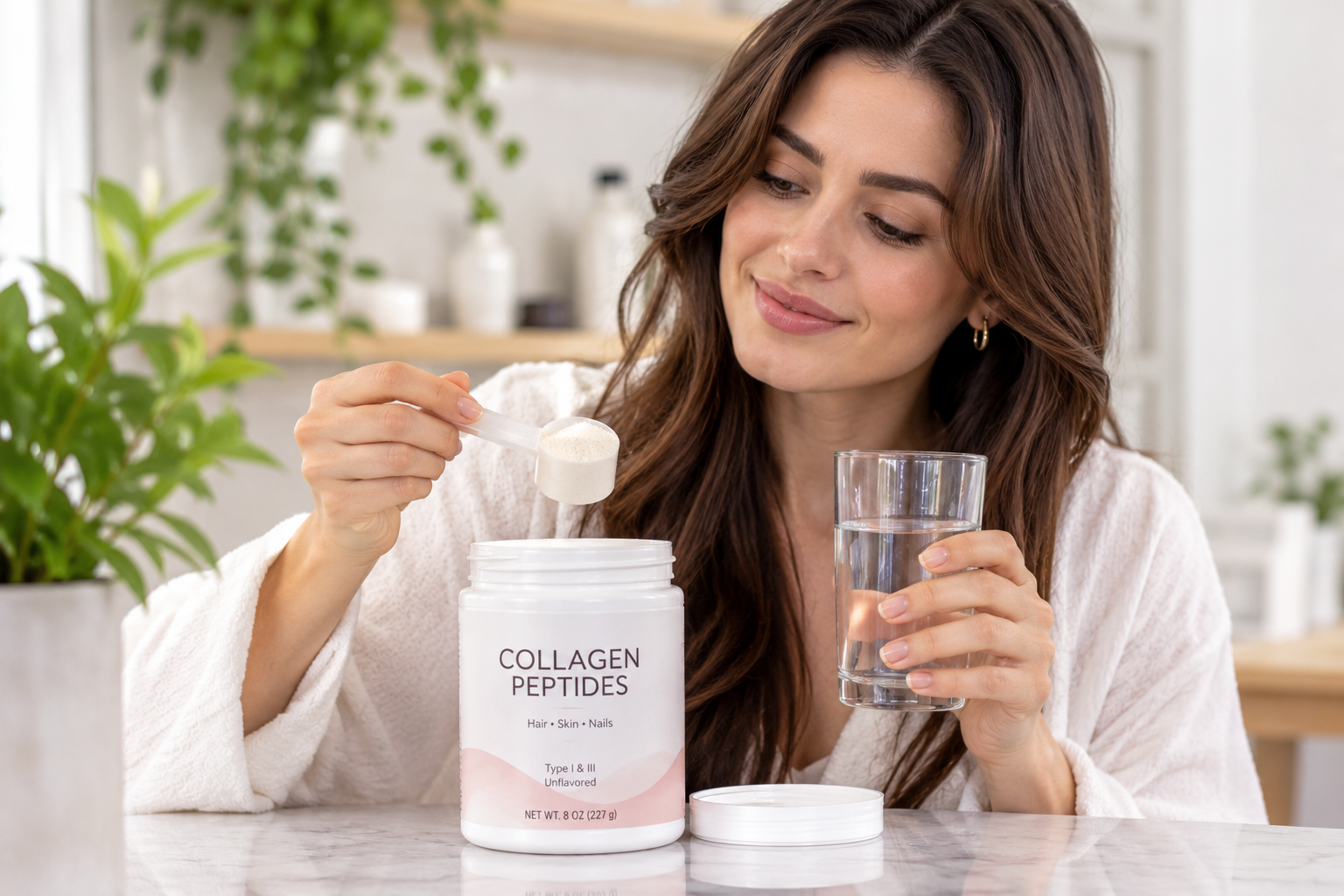
Powder is easy to mix into water, smoothies, or other drinks. It can also provide several grams of collagen in one serving.
Check whether it dissolves comfortably for you and whether it contains added flavors, sweeteners, or other ingredients.
Collagen Capsules
Capsules are convenient for travel and people who do not like mixing powders.
However, check the total collagen amount per daily serving. Some products provide relatively small amounts per capsule, so the serving may require multiple capsules.
Liquid Collagen
Liquid products are ready to consume and may contain additional ingredients.
Compare the collagen amount, serving size, added sugars, and cost per gram. A more expensive liquid product is not automatically more effective than a powder.
Collagen Gummies
Gummies may be convenient, but their collagen content can vary considerably.
Check the actual collagen amount per serving rather than relying on the front-of-package claims. Also look at added sugar and other ingredients.
The format alone does not tell you which product works best. The ingredient amount, formulation, product quality, and evidence are more useful factors to compare.
Does Collagen Need Vitamin C?
Vitamin C is essential for normal collagen formation in the body. It plays a role in the processes that help the body produce and maintain collagen.
You can obtain vitamin C from foods such as:
- Oranges and other citrus fruits
- Strawberries
- Bell peppers
- Broccoli
- Kiwi
- Tomatoes
Getting enough vitamin C is important for normal health. However, that does not prove that taking extra vitamin C with a collagen supplement guarantees better skin results.
A balanced diet is a sensible foundation. You do not need to assume that a high-dose vitamin C supplement is necessary just because you are considering collagen.
What Collagen Supplements Will Not Do
Collagen supplements are often advertised with dramatic promises. It is important to separate those claims from what research has actually established.
Collagen supplements have not been proven to:
- Erase deep wrinkles
- Lift sagging skin
- Replace sunscreen or retinoids
- Stop the natural aging process
- Target one specific area of the body
- Produce guaranteed changes in skin firmness
- Replace a balanced diet or medical treatment
They should also not be treated as a cure for joint disease, bone loss, or other medical conditions. Research on those outcomes is separate from research on skin.
Are Collagen Supplements Safe?
Hydrolyzed collagen supplements have generally been well tolerated in many short-term studies, but that does not mean every product is suitable for every person.
Possible unwanted effects may include digestive discomfort, bloating, fullness, or an unpleasant aftertaste.
The source of collagen also matters. Marine collagen may be unsuitable for people with fish allergies, while bovine collagen may be unsuitable for people with relevant beef-derived ingredient allergies.
Before buying a product, check:
- The source of collagen
- The full ingredient list
- The serving size and amount of collagen
- Allergen information
- Added sugars, flavors, and sweeteners
- Quality and contaminant testing information
Third-party testing can provide additional quality information. Look for clear details about the testing organization and what it verifies. A certification or quality seal should not be interpreted as proof that a product improves skin.
Talk with a qualified healthcare professional before starting a supplement if you are pregnant or breastfeeding, have a medical condition, follow a medically restricted diet, or take medication and are unsure about possible interactions.
The FDA does not approve dietary supplements for safety and effectiveness before they are marketed in the same way it approves medicines. Be cautious of products that promise to treat disease, reverse aging, or deliver guaranteed results.
Collagen Supplements vs. Topical Skincare: What Matters More?
Collagen supplements and topical skincare are not interchangeable. They work through different routes, and the evidence behind each skincare approach is different.
If your goal is to care for visible signs of skin aging, focus on the basics first.
1. Daily Sunscreen
Broad-spectrum sunscreen helps protect skin from ultraviolet damage, an important contributor to premature skin aging.
Use a sunscreen that suits your skin and apply it consistently when exposed to daylight. For more guidance, see our winter skin care routine.
2. Retinoids
Retinol and retinal are vitamin A derivatives used in topical skincare. They have more established evidence for improving certain signs of photoaging than oral collagen supplements.
3. Moisturizers and Skin-Barrier Care
Ingredients such as glycerin, ceramides, and hyaluronic acid can help support skin hydration and barrier care.
You can learn more in our guide: What Is Hyaluronic Acid? Benefits and Uses.
4. Other Skincare Ingredients
Ingredients such as niacinamide, vitamin C, and certain peptides may be useful depending on your skin concerns and routine.
5. Collagen Supplements
Collagen supplements may be an optional addition for people interested in the possible benefits, but the evidence remains mixed. They should not replace established skincare habits.
How to Choose a Collagen Supplement
If you decide to compare collagen products, avoid choosing one based only on influencer recommendations or phrases such as “beauty collagen.”
Use this checklist instead:
- Check the collagen form: Look for hydrolyzed collagen or collagen peptides if you want a product similar to many skin-study formulations.
- Identify the source: Check whether it is marine, bovine, or another animal-derived source.
- Read the amount per serving: Make sure the label clearly states how much collagen the serving contains.
- Review the complete ingredient list: Look for added sugars, flavorings, and other ingredients you may not want.
- Check allergen information: Do not assume a product is suitable just because it is marketed for skin.
- Look for quality testing: Prefer transparent information about independent testing for identity, purity, and contaminants.
- Be skeptical of promises: Claims about instant lifting, wrinkle removal, or guaranteed results are warning signs.
A higher price does not prove better quality or better results. Compare the actual formulation and available quality information before spending money.
Frequently Asked Questions
Do collagen supplements really work for skin?
Some studies report improvements in measured skin hydration and elasticity, but the overall evidence is mixed. Higher-quality and independent research has raised questions about whether the benefits are reliable. Collagen supplements are not proven wrinkle treatments.
What is the best type of collagen for skin?
Many skin-focused studies have examined hydrolyzed collagen peptides, often containing Type I collagen. However, there is not enough evidence to say that one source or type is definitively best for everyone.
Is marine collagen better than bovine collagen?
Not necessarily. Marine collagen is commonly Type I, while bovine collagen often contains Types I and III. Both sources have been used in research. Choose based on dietary preferences, allergies, product quality, and cost rather than assuming one is dramatically more effective.
How long does collagen take to work?
There is no guaranteed timeline. Some studies have measured changes after several weeks, while other outcomes have required longer periods. Around 8 to 12 weeks is a common research timeframe, not a promise that you will see results.
Should I take collagen with vitamin C?
Your body needs vitamin C for normal collagen production. Eating enough vitamin C-rich foods is a sensible approach. However, there is not enough evidence to promise that taking an additional vitamin C supplement alongside collagen will improve skin results.
Are collagen gummies as good as powder?
The format does not determine effectiveness. Compare the total collagen amount per serving, the ingredients, and the cost. Gummies may provide less collagen per serving than some powders, but the label is what matters.
Is vegan collagen the same as collagen peptides?
No. True collagen peptides are animal-derived. Products marketed as vegan collagen are generally formulas containing nutrients intended to support the body’s own collagen production. They are not the same ingredient.
Can I use collagen supplements with retinol or vitamin C serum?
Oral collagen and topical skincare products are different types of products. There is no established reason to assume they must be used at different times, but research has not established that combining them produces extra anti-aging benefits. Introduce new skincare products carefully so you can identify irritation or other reactions.
Can collagen supplements remove wrinkles?
There is not reliable evidence that collagen supplements remove wrinkles. Some studies report improvements in skin measurements, but the evidence for visible wrinkle reduction is less convincing.
Should everyone take collagen supplements?
No. Collagen supplements are optional, and there is no established need for everyone to take them. A balanced diet and consistent skincare habits are more important foundations.
Final Verdict: Are Collagen Supplements Worth Trying?
Collagen supplements are popular for a reason: early studies and some newer reviews suggest they may support skin hydration and elasticity. But the evidence is not consistent, and the strongest questions concern study quality, industry funding, and whether measured changes translate into visible improvements.
If you are considering collagen, make your decision with realistic expectations. Check the source, formulation, serving amount, and product quality. Do not expect it to erase wrinkles, lift skin, or replace sunscreen and a well-planned skincare routine.
For most people, the sensible priority is to maintain sun protection, use a moisturizer that supports the skin barrier, and choose evidence-based topical ingredients when appropriate. Collagen supplements remain an optional extra—not a skincare essential.
Disclaimer: This article is for general educational purposes only and is not medical advice. Dietary supplements are not intended to diagnose, treat, cure, or prevent disease. Research findings do not guarantee individual results. Speak with a qualified healthcare professional before starting a supplement if you are pregnant, breastfeeding, have a medical condition, follow a medically restricted diet, or take medication.
Sources
- Pu SY, et al. (2023). Effects of Oral Collagen for Skin Anti-Aging: A Systematic Review and Meta-Analysis. Nutrients.
- Myung S-K, Park Y. (2025). Effects of Collagen Supplements on Skin Aging: A Systematic Review and Meta-Analysis of Randomized Controlled Trials. The American Journal of Medicine.
- Batool S, et al. (2026). Oral Collagen Peptides and Skin Rejuvenation: A Systematic Review and an Updated Meta-Analysis of Randomized Controlled Trials. Journal of Cosmetic Dermatology.
- U.S. Food and Drug Administration (FDA). Questions and Answers on Dietary Supplements.