Quick Answer
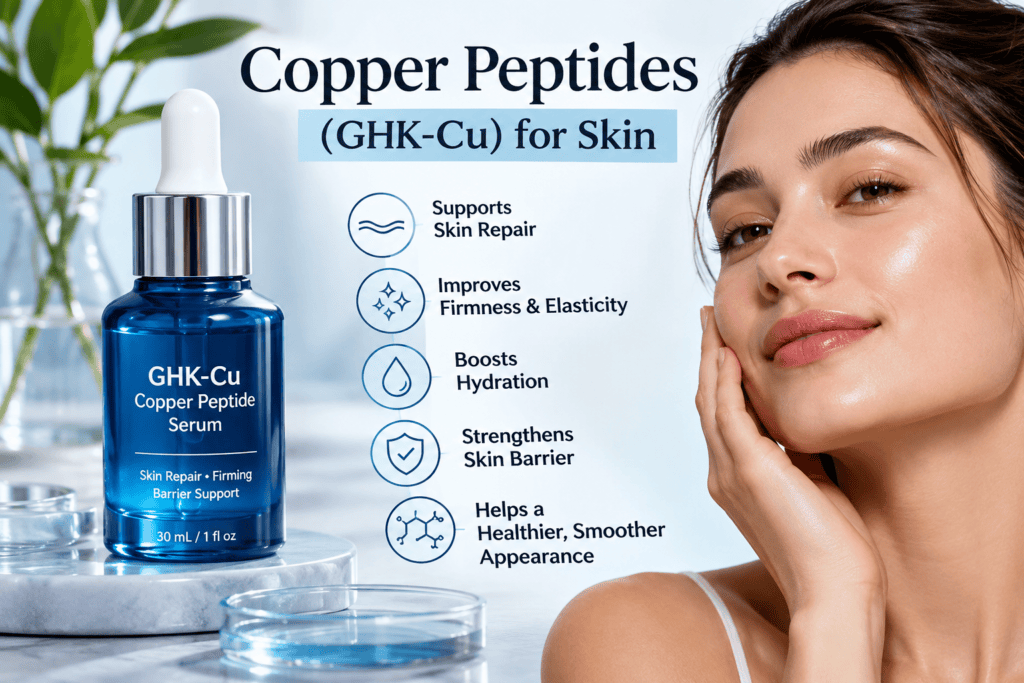
Copper peptides — most commonly GHK-Cu, a small peptide made of three amino acids bound to copper — are a gentler, firming-focused skincare ingredient. They are used to support collagen and elastin, so skin can look firmer and smoother over time, usually with less irritation than retinol.
Copper peptides are not a proven replacement for retinol. Retinol has a far larger and longer research base for fine lines and skin renewal. The human research on copper peptides is smaller, shorter, and often industry-supported, and the improvements it shows are modest. What copper peptides offer instead is tolerability: many people who had to stop retinol because of peeling and redness can use them comfortably.
One simple rule: start with copper peptides if your skin is sensitive or has never tolerated retinol. Start with retinol if fine lines are your main concern and your skin copes well with actives. Use both, on alternate nights, only if your skin stays calm.
Give the routine at least 8 to 12 weeks of consistent use, with daily sunscreen, before you judge it. Peptides work gradually, not overnight.
What Are Copper Peptides?
Peptides are short chains of amino acids. In skincare they act as messengers, signalling skin cells to do a job — build, repair, or calm down. Copper peptides are peptides that carry a copper ion, and the best-known one is GHK-Cu.
GHK stands for glycyl-histidyl-lysine: a tripeptide, meaning three amino acids joined together, that binds copper tightly. This tripeptide occurs naturally in the human body, in blood plasma, saliva, and urine, and its levels fall with age. On a product label, look for the ingredient names Copper Tripeptide-1, GHK-Cu, or copper peptide complex.
Copper matters because the body uses it as a helper — a cofactor — for enzymes involved in forming and cross-linking collagen, the protein that gives skin its structure. That is why copper peptides are talked about for firmness and elasticity, rather than for exfoliation or acne.
How Copper Peptides Work
1. Signal. GHK-Cu signals fibroblasts — the cells in the deeper skin layer that make collagen and elastin — to support repair and new collagen production.
2. Support. Copper helps the enzymes that cross-link and stabilise collagen fibres, so new collagen holds its structure better.
3. Remodel. GHK-Cu also influences the enzymes that break collagen down, which is part of normal, healthy skin remodelling: old, damaged matrix is cleared and replaced.
4. Calm. Unlike retinoids, copper peptides do not work by speeding up surface cell shedding, so they usually cause far less peeling, flaking, and redness.
That last point matters in winter, when skin is already dry and the barrier is under stress. A gentler firming ingredient is often easier to keep using every day than a strong retinoid. For the full cold-weather routine, see our Winter Skin Care Routine.
What the Evidence Actually Shows
This is the part most copper peptide articles skip, so read it before you spend money.
In laboratory studies, GHK-Cu increased collagen production in skin fibroblasts at very low concentrations, and animal wound-healing studies showed more collagen and faster repair. That is real activity — in a dish and in wounds, not yet proof of what a face serum will do.
In people, the studies are small and short, typically around 12 weeks, and many were supported by the companies selling the products. They report modest improvements in the look of firmness, skin density, and fine lines — not dramatic change.
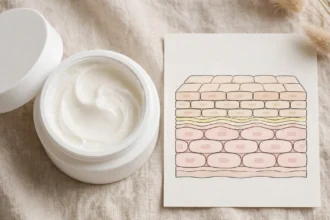
GHK-Cu loves water, and skin’s outer barrier is oily. How much of the peptide in an ordinary serum actually reaches the deeper skin is still an open formulation question in the research, which is one reason results vary so much between products and people.
No good evidence shows copper peptides lifting sagging skin, erasing deep wrinkles, firming the neck on their own, or fading pigmentation. If a product promises those, it is marketing, not research.
What this means before you spend money
The honest summary: copper peptides are a reasonable, well-tolerated supporting ingredient with modest expected results — an extra in a routine built on cleansing, moisturising, and sunscreen, not the foundation of it.
Benefits: What Copper Peptides Can and Cannot Do
What they may help with
Skin that looks and feels a little firmer and bouncier with consistent use
A smoother appearance of fine lines over 8 to 12 weeks
Support for skin that feels thin, tired, or less elastic
A gentler anti-ageing option for sensitive skin, or for people who cannot tolerate retinoids
Routines built around hydration — many copper peptide serums also contain hyaluronic acid and amino acids
For hydration layering, see What Is Hyaluronic Acid? — what it does, and how to apply it so it actually helps.
What they cannot do
Replace sunscreen, or prevent ageing on their own
Lift sagging skin or remove deep wrinkles and texture the way in-clinic treatments can
Beat retinol on evidence — retinol remains the better-proven ingredient for fine lines and resurfacing
Work in two weeks. Any claim of instant firming is marketing, not biology
Copper Peptides vs Retinol: Side by Side
| Copper Peptides (GHK-Cu) | Retinol | |
| What it is | A tripeptide bound to copper | A vitamin A derivative |
| Main job | Signal collagen and elastin support; firmness | Speed cell turnover; resurface skin; smooth fine lines |
| Strength of evidence | Smaller, shorter, often industry-supported human studies | Far larger research base built over decades |
| Irritation | Usually low; little or no peeling | Dryness, peeling and redness are common at first |
| When to use it | Morning or night | Night only |
| Best for | Sensitive skin, firmness, people who cannot tolerate retinoids | Fine lines, texture, experienced users of actives |
| How long to judge it | At least 8 to 12 weeks of consistent use | Allow a 4 to 8 week adjustment period, then judge over months |
| Pregnancy | Safety in pregnancy is not established — ask a doctor first | Retinoids are commonly avoided in pregnancy — ask a doctor |
No published study found for this guide shows that retinol and copper peptides cancel each other out. The real risk of combining actives is irritation from doing too much at once, not cancellation.
Choosing between the vitamin A options themselves? Our Retinal vs Retinol guide compares speed, strength, and irritation in full.
Copper Peptides vs Retinal
Retinal, short for retinaldehyde, sits one step above retinol in the vitamin A family. Skin must convert retinol twice before it becomes the active form, retinoic acid, but retinal only once — so retinal is generally faster-acting, and it suits experienced users who already tolerate retinol well.
The simple order, from gentlest to strongest, is:
Gentlest start: copper peptides, for firmness support with the least irritation.
Classic and best-evidenced: retinol, two or three nights a week to start, buffered with moisturiser.
Faster retinoid: retinal, starting at a low strength and building slowly.
You do not need all three. Pick one retinoid path, add copper peptides only if you want them, and give the combination time to work.
How to Use Copper Peptides, Step by Step
1. Cleanse. Wash your face with a gentle cleanser and pat dry.
2. Apply the serum. Apply a pea-to-pump amount of copper peptide serum to clean, dry skin, before heavier serums and creams. Once a day is enough to start; morning or night both work.
3. Follow with moisturiser. Most copper peptide serums are light and watery, so seal them in, especially in winter.
4. Use sunscreen in the morning. SPF 30 or higher, every day. No firming ingredient can out-work daily sun damage.
A simple morning and evening routine
| Morning | Evening | |
| Step 1 | Gentle cleanser, or rinse with water | Gentle cleanser |
| Step 2 | Vitamin C serum, if you use one | Copper peptide serum |
| Step 3 | Moisturiser | Moisturiser |
| Step 4 | Sunscreen SPF 30+ | On retinoid nights: retinol or retinal instead of the copper peptide serum, then moisturiser |
A simple weekly rhythm, if you also use a retinoid
First night: retinoid, then moisturiser.
The next night: copper peptide serum, then moisturiser.
On the third night: moisturiser only, if your skin feels tight or sensitive.
Every morning: gentle cleanse, moisturiser, sunscreen; add a hydrating serum only if your skin needs it.
If your skin stays calm for two weeks, you can use copper peptides more often. If it stings, peels, or turns red, cut back to alternate nights and pause the retinoid first — the copper peptide is usually the gentler partner to keep.
What Pairs Well With Copper Peptides — and What to Keep Apart
| Ingredient | Pairing advice |
| Hyaluronic acid | Pairs well. Use it for hydration in the same routine. |
| Niacinamide | Pairs well. Supports the skin barrier and is generally calm alongside peptides. |
| Ceramide moisturisers | Pairs well. A simple, fragrance-free ceramide cream helps tolerance in winter. |
| Retinol or retinal | Use on alternate nights at first, or as the evening step on retinoid nights only once your skin is settled. |
| Vitamin C (ascorbic acid) | Keep apart: vitamin C in the morning, copper peptides in the evening. Many vitamin C serums are acidic, and that low pH may destabilise the copper peptide. |
| Strong exfoliating acids (AHA/BHA) | Keep apart if your skin is sensitive. Use acids on a different night, and keep frequency low in winter. |
| Benzoyl peroxide | Keep apart. Use it at a different time of day, for spot treatment only, and stop if irritation builds. |
How to Choose a Copper Peptide Serum
Copper Tripeptide-1, GHK-Cu, or copper peptide complex should appear on the ingredient list. A product that only says ‘peptide blend’ on the front may contain very little copper peptide — or none.
A named percentage, such as 1% copper peptides, is more useful than vague ‘high strength’ claims. More is not proven to be better, because no human study has established a best concentration.
Blue or blue-green serums are normal: the colour comes from the copper itself, and it fades as the serum spreads.
Simple formulas with hydrating ingredients — hyaluronic acid, glycerin, amino acids — are easier to layer than serums stacked with several other strong actives.
Two examples readers ask about
The Ordinary Multi-Peptide + Copper Peptides 1% Serum is a lower-cost starting point, and NIOD Copper Amino Isolate Serum is a premium option aimed at experienced users. Neither is a hands-on recommendation: check the current formula, size, and price on the retailer’s own site before you buy, because formulas and prices change.
Whatever you choose, buy one product, use it consistently, and judge it on your own skin over 8 to 12 weeks. Swapping serums every fortnight tells you nothing.
Who Should Try Copper Peptides?
A good fit if you
Have sensitive skin, or stopped retinol because of peeling and redness
Want firmer, smoother-looking skin without a harsh adjustment period
Are building a winter routine and need a gentler active
Already use vitamin C in the morning and want a repair-focused evening step
Think twice, or get advice first, if you
Are pregnant or breastfeeding — safety is not established, so ask a doctor before starting any new active
Have eczema, rosacea, or broken or freshly treated skin — ask a dermatologist first, and never apply a new active to broken skin unless they advise it
Are allergic to copper, or to any other ingredient in the specific product — patch test first
Expect a serum to remove deep wrinkles or lift sagging skin — that is not a realistic outcome for any serum
Are already using several strong actives and your skin is irritated — simplify first, then add one product at a time
Side Effects and How to Patch Test
Copper peptides are usually well tolerated, but ‘gentle’ does not mean risk-free. Possible problems include mild redness or stinging, especially when combined with strong acids; irritation from stacking too many actives at once; and contact allergy to another ingredient in the formula.
Patch test like this: apply a small amount to your jawline or behind your ear, once a day for 3 to 5 days, before using it on your whole face. If you develop spreading redness, swelling, itching, or a rash, stop using it and seek medical advice if it does not settle.
Introduce one new product at a time, with at least a week between additions. If something goes wrong, you will know which product caused it.
Common Mistakes to Avoid
1. Expecting results in two weeks, then quitting just before the 8 to 12 week point where judging makes sense.
2. Layering copper peptides with a strong acid or a low-pH vitamin C serum in the same step.
3. Using a retinoid every night from day one, then blaming the copper peptide for the irritation.
4. Skipping sunscreen, which undoes the collagen you are trying to protect.
5. Buying on a percentage claim alone, without checking that Copper Tripeptide-1 is actually on the ingredient list.
6. Using the serum on broken, freshly microneedled, or freshly lasered skin without a dermatologist’s advice.
Frequently Asked Questions
Can I use copper peptides every day?
Yes. Most people who tolerate them can use a copper peptide serum once a day, in the morning or the evening. Start once a day rather than twice, and increase only if your skin stays calm after two weeks.
Can I use copper peptides with retinol?
Yes, and alternate nights is the safest way to start: retinoid one night, copper peptides the next. There is no good evidence that the two cancel each other out. The practical risk is irritation from stacking actives, so build up slowly and pause the retinoid first if your skin reacts.
Can I use copper peptides with vitamin C?
Yes, if you separate them. Use vitamin C in the morning, for daytime antioxidant support, and copper peptides in the evening. Many vitamin C serums are formulated at a low, acidic pH to keep vitamin C stable, and that environment may destabilise the copper peptide if they are applied in the same step.
Are copper peptides better than retinol?
No — not on evidence. Retinol has a much larger and longer research base for fine lines and skin renewal. Copper peptides are the gentler option, and for sensitive or retinoid-intolerant skin that trade-off is often worth it. For many people the best answer is both, on different nights, rather than either one alone.
How long do copper peptides take to work?
Judge them after at least 8 to 12 weeks of consistent use, with daily sunscreen. Hydration and a smoother feel can show earlier, but any firmness change is gradual. Taking a photo in the same lighting every few weeks is a more honest way to track progress than checking the mirror daily.
Do copper peptides help acne scars or dark spots?
Only modestly, and only in appearance. By supporting skin repair they may soften the look of post-acne marks over time, but they do not remove raised scars, deep texture, or pigmentation, and they are not an acne treatment. Treat active acne first. For dark marks specifically, see our Tranexamic Acid for Dark Spots guide.
Should I stop retinol and switch completely to copper peptides?
Only if retinol irritates you consistently despite low frequency, buffering with moisturiser, and a low strength — or if a dermatologist advises it. If retinol works for you and your skin tolerates it, there is no need to switch. You can add copper peptides on alternate nights if you want extra firming support.
How do copper peptides compare with PDRN serum?
They are different ingredients with different stories. PDRN is a DNA-fragment ingredient, originally used in clinic treatments, and the evidence for it in ordinary topical serums is still limited. Copper peptides are peptide messengers aimed at firmness. Neither should be bought on trend alone — read our PDRN Serum guide for what it can and cannot do.
Are copper peptides safe in pregnancy?
Their safety in pregnancy and while breastfeeding has not been established. That is not the same as proof of harm, but it does mean the careful answer is to ask your doctor before starting them, and to apply the same caution to retinoids, which are commonly avoided in pregnancy.
Key Takeaways
Copper peptides (GHK-Cu) signal skin to support collagen and elastin, usually with far less irritation than retinol.
Retinol still has the stronger evidence base. Copper peptides are the gentler alternative, not a proven better one, and their human results so far are modest.
Use a copper peptide serum once a day to start, before moisturiser, and wear sunscreen every morning.
Keep vitamin C in the morning and copper peptides in the evening, and alternate nights with a retinoid at first.
Judge the routine after 8 to 12 weeks — not after one week.
Patch test, add one product at a time, and ask a doctor first if you are pregnant, breastfeeding, or treating a skin condition.
Sources and References
Pickart, L. and Margolina, A. (2018). Regenerative and Protective Actions of the GHK-Cu Peptide in the Light of the New Gene Data. International Journal of Molecular Sciences — a review of GHK-Cu’s effects on collagen, skin remodelling, and gene expression.
Maquart, F.-X. et al. (1988). Stimulation of collagen synthesis in fibroblast cultures by the tripeptide-copper complex glycyl-L-histidyl-L-lysine-Cu2+. FEBS Letters — the laboratory study showing increased collagen synthesis in fibroblast cultures.
Product ingredient lists, formulas, and prices change. Always check the label of the specific product you buy, and the retailer’s own page, before relying on any detail in this guide.
This guide is general skincare information, not medical advice. Individual results vary. Patch test new products, and talk to a healthcare professional before changing your routine if you are pregnant, breastfeeding, have a skin condition, or use prescription treatments.